
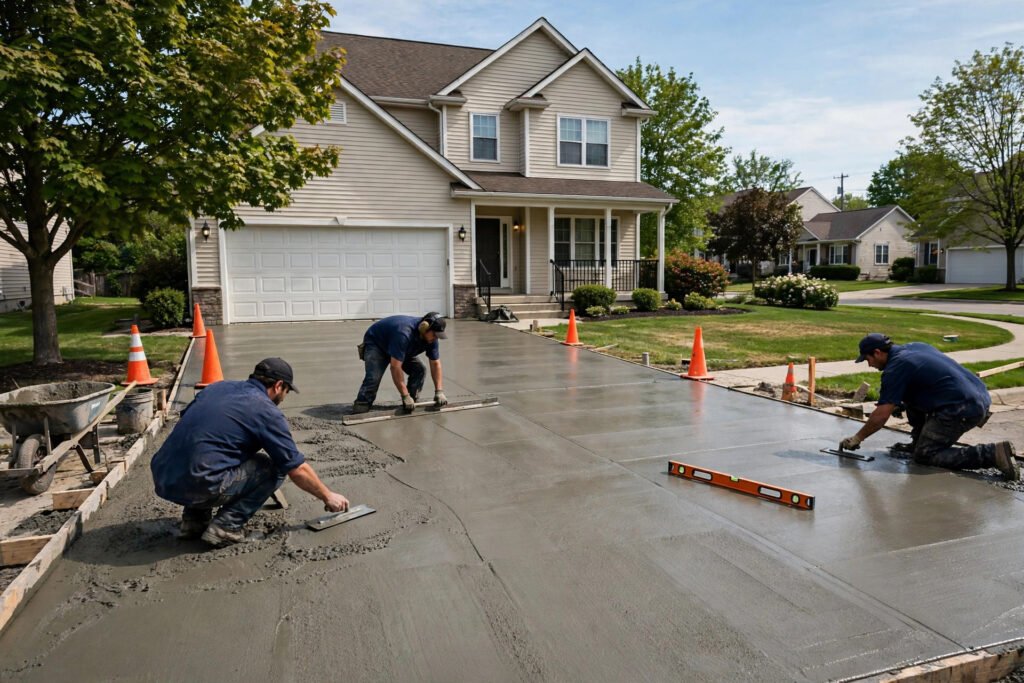
If your driveway is cracked, heaving, or patched so many times it looks like a quilt, your concrete driveway cost is probably the first number you want — before you call anyone for a quote. In 2026, most homeowners pay $6 to $15 per square foot installed for a new concrete driveway, with a standard two-car driveway (about 600 square feet) commonly landing between $4,200 and $8,500 for plain broom-finished concrete. Decorative finishes, thicker slabs, demolition of an old driveway, and drainage work can push that total to $10,000–$18,000 or more. This guide breaks down what each size and finish actually costs, what a complete quote should include, and how to tell a fair bid from one that will crack — literally — in two winters.
The quick answer
Concrete driveway cost comes down to four things: size, thickness, finish, and what has to come out first. A plain 4-inch slab with a broom finish on a prepared, flat site is the cheapest common job. A 5- or 6-inch slab with rebar, a stamped or exposed-aggregate finish, and full tear-out of an old asphalt or concrete driveway costs two to three times as much — and sometimes that extra spend is justified by soil, climate, and heavy vehicles, and sometimes it is pure upsell.
| Driveway size | Approx. area | Plain concrete installed (2026) |
|---|---|---|
| Single-car, 10×20 ft | 200 sq ft | $1,400 – $3,000 |
| Standard single, 12×24 ft | 288 sq ft | $2,000 – $4,300 |
| Double-car, 20×20 ft | 400 sq ft | $2,800 – $6,000 |
| Two-car, 24×24 ft | 576 sq ft | $4,000 – $8,600 |
| Large two-car, 24×30 ft | 720 sq ft | $5,000 – $10,800 |
| Long or rural driveway, 12×60 ft | 720 sq ft | $5,200 – $11,500 |
Want a ballpark for your exact project before you talk to a contractor? Run your numbers through our free Project Cost Calculator — enter your project size and finish level, and you’ll get a realistic low–high range in seconds to bring to every quote appointment.
Costs in this guide are national ranges for planning purposes. Your local quotes will vary by region, materials, site condition, and scope — always get at least three written bids on the same scope before you hire.
Concrete driveway cost per square foot by finish
The finish is where driveway quotes diverge the most, because two driveways can be the same size and thickness and still differ by $5,000 in decorative work alone.
Plain broom finish ($6–$10 per sq ft installed). The standard residential driveway: poured, leveled, and textured with a broom for traction. It is durable, easy to repair in sections, and the best value if function matters more than looks. Most of the ranges in the table above assume this finish.
Brushed with borders or simple scoring ($7–$12 per sq ft installed). Adds a smooth border, picture-frame edge, or saw-cut pattern lines. A modest upgrade that makes a plain driveway look intentional without the full cost of stamping.
Exposed aggregate ($9–$15 per sq ft installed). The surface is washed to reveal decorative stone in the mix. It hides stains and minor wear well, offers excellent traction, and suits warmer climates. It costs more in materials and labor and is harder to patch invisibly.
Stamped concrete ($12–$20 per sq ft installed). Poured concrete pressed with patterns that mimic brick, stone, or pavers, usually with integral color or a color hardener. It delivers a premium look for less than real pavers, but it needs resealing every 2–3 years, and stamped surfaces can be slippery when wet if a grit additive is skipped. Budget for that maintenance as part of the true cost.
Colored / stained concrete (add $2–$5 per sq ft). Integral color (mixed through the slab) holds up better than surface stains on a driveway that takes tire traffic and snow shoveling. Two-tone releases and antiquing on stamped work sit at the top of this range.
Concrete pavers, for comparison ($15–$30 per sq ft installed). Not poured concrete at all, but often quoted alongside it. Individual pavers can be replaced after damage, which poured slabs cannot — but the upfront cost is the highest in this category.
What a complete quote should include
Concrete quotes are where line items quietly disappear — or quietly balloon on pour day, when it is too late to get another bid. A complete written quote should spell out:
- Demolition and disposal: whether tear-out of the old driveway is included, and at what price. Removing old concrete typically adds $2–$5 per sq ft; asphalt removal is usually a little less. Disposal fees should be named, not buried.
- Base preparation: excavation depth, compacted gravel base thickness (typically 4–6 inches), and whether poor soil will be removed and replaced. A slab is only as good as the base under it — this line matters more than almost any other.
- Slab thickness: 4 inches is the residential standard for cars; 5–6 inches is the right call for heavy trucks, RVs, or work vehicles. The thickness should be written in the contract, not just said out loud.
- Reinforcement: wire mesh, rebar (often #3 or #4 on 18–24 inch centers), or fiber mesh — and which one your price includes. Reinforcement does not prevent cracking, but it holds cracks tight and keeps sections level.
- Concrete strength: the mix in PSI — 3,500–4,000 PSI is typical for driveways, with air-entrained mix essential in freeze-thaw climates.
- Joints: control joints spaced and cut or tooled at the right intervals (roughly every 8–12 feet) and expansion joints where the driveway meets the garage and the street. Joints are how a pro tells the concrete where to crack so it does not choose on its own.
- Drainage and slope: the driveway should slope away from the garage and house (about 1–2%). If your lot needs a drain, swale, or regrading, it should be priced in writing before the pour.
- Curing and sealing: how the slab will be cured, when you can walk on it (usually 24–48 hours), when you can park on it (typically 7 days, longer for heavy vehicles), and whether an initial sealer is included.
- Permits and inspections: who pulls any required permit and handles setback or apron rules at the street. Many cities regulate the driveway apron and curb cut separately from the slab itself.
- Warranty: workmanship warranty length in writing, and what it covers — settlement, heaving, and spalling are different failures with different causes.
If a quote is just a per-foot number with none of this in writing, do not sign it. Compare it against at least two other itemized bids on the same thickness, base, and finish, and use our 12-step contractor hiring checklist to verify licenses, insurance, and references before you choose.
Replacement vs. resurfacing vs. repair: which do you actually need?
Not every tired driveway needs a full replacement, and a trustworthy contractor will tell you which tier your driveway is really in.
Repair ($300–$1,500 for typical jobs) makes sense when damage is isolated: a few narrow cracks, one settled corner, or minor spalling on an otherwise sound slab. Crack filling, mudjacking or polyjacking to lift a sunken section ($5–$15 per sq ft of lifted area), and patching can buy a solid driveway several more years. A handyman can handle the smallest cosmetic fixes, but lifting and structural patching belong with a concrete contractor.
Resurfacing / overlay ($3–$7 per sq ft) applies a thin new layer over sound concrete to refresh the look. It only works if the base slab is structurally solid — an overlay over a heaving or badly cracked slab will mirror those cracks within a season or two. Be cautious with any pitch that recommends an overlay without checking what is happening underneath.
Full replacement ($6–$15 per sq ft for plain concrete) is the right call when cracks are wide and branching across most of the surface, sections have heaved unevenly (a trip hazard and a plow-catcher), the slab is 20–30+ years old with widespread spalling, or drainage problems need the slope rebuilt from the base up. Replacement is also your one chance to widen the driveway, add a parking pad or turnaround, and fix the apron — changes that are cheap to add during a tear-out and expensive to do later.
What drives the price up (or down)
- Tear-out. An old concrete driveway is heavy, slow demolition. If your quote assumes the crew can pour over or beside the old slab and that turns out to be wrong, the change order will be painful. Confirm tear-out in writing.
- Thickness and reinforcement. Stepping from 4 inches with fiber mesh to 6 inches with rebar adds roughly $1.50–$3.50 per sq ft — worth it for heavy vehicles and soft soil, unnecessary upsell for a standard car on good ground.
- Site access. A backyard or long driveway a concrete truck cannot reach means pump rental ($400–$800 per pour is common) or wheelbarrow labor. Tight urban lots cost more than open suburban ones for the same slab.
- Soil and drainage. Clay soil, a high water table, or a driveway that currently ponds water all add excavation, base, or drain costs. These are legitimate when documented — ask to see the reasoning in the bid.
- Region and season. Labor and concrete prices in high-cost metros can run 20–35% above national averages. In cold climates, spring is peak season; a fall pour scheduled before the ground freezes is sometimes priced more flexibly — but concrete should never be poured on frozen ground or without cold-weather curing plans.
- Apron and curb work. The section between the sidewalk and the street is often city-regulated and sometimes city-inspected. Replacing it adds cost and occasionally a separate permit — clarify whether it is in your contractor’s scope or yours.
- Bundling exterior work. If you are already planning exterior painting or other curb-appeal work, sequence the concrete first: fresh paint and fresh concrete do not mix well when trucks and mixers are still coming and going.
How long does a concrete driveway take — and how long does it last?
Once permits and scheduling are sorted, the work itself is quick: tear-out and base prep usually take 1–2 days, forms and reinforcement half a day to a day, and the pour itself often a single day for a residential driveway. The wait is in the curing: keep cars off for at least 7 days (your contractor’s written instruction governs — heavy vehicles may need 28 days, when concrete reaches full design strength).
A properly built concrete driveway lasts 25–40 years. The habits that get it there are simple: seal it every 2–3 years in harsh climates, keep de-icing salts off it in its first winter (use sand for traction instead), fill narrow cracks before water gets in and freezes, and keep heavy delivery and construction vehicles off residential-thickness slabs. Most premature failures trace back to a thin base, no reinforcement, or water trapped under the slab — which is why the base and drainage lines in your quote matter more than a small difference in the per-foot price.
Concrete vs. asphalt vs. gravel: an honest comparison
Homeowners often ask whether concrete is worth its premium. The honest answer depends on climate and how long you will stay.
- Asphalt ($4–$9 per sq ft installed) costs less up front and can be driven on sooner, but it needs sealcoating every 3–5 years and typically lasts 15–25 years. It handles freeze-thaw flex a little more forgivingly and is the norm in many northern markets.
- Concrete ($6–$15 per sq ft installed) costs more up front, needs less routine maintenance, reflects heat better in hot climates, and lasts longer — the better lifetime value if you will own the home for a decade or more.
- Gravel ($1–$4 per sq ft installed) is the budget option for long rural driveways, with ongoing costs in regrading and fresh stone. It is not a like-for-like substitute in most suburbs, and some HOAs and cities do not allow it.
Whichever surface you choose, be wary of the classic pressure patterns — a quote far below every other bid, a demand for most of the money before the pour, or a “leftover concrete from another job” discount offered at your door. Those are textbook examples in our guide to contractor scams and red flags. Real concrete cannot wait in a truck while someone knocks on doors; that pitch is a scam by definition.
Frequently asked questions
How much does a concrete driveway cost for a two-car home?
For a typical 24×24 ft two-car driveway (576 sq ft), most homeowners pay $4,000–$8,600 for plain broom-finished concrete including tear-out of a standard old driveway. Stamped or exposed-aggregate finishes on the same footprint commonly run $7,000–$12,000. Run your exact dimensions through our Project Cost Calculator for a tighter range before you collect bids.
How thick should a concrete driveway be?
Four inches is the standard for passenger cars on a well-compacted base. Go to 5–6 inches if you regularly park a heavy truck, RV, boat trailer, or work vehicle on it — and make sure the thickness, base depth, and reinforcement are all written into the contract, because you cannot verify any of them once the slab is poured.
Can I pour a new driveway myself?
You save the labor portion, but concrete is unforgiving in a way most DIY work is not: you have a short working window, the base and forms must be right before the truck arrives, and a poorly finished or poorly jointed slab cannot be un-poured. Forming and pouring a small pad is a reasonable project for an experienced DIYer with help on pour day; a full driveway — especially a tear-out and replacement — is where a pro crew earns its rate.
Do I need a permit for a concrete driveway?
Often, yes — or at least for part of the job. Many cities require a permit for a new or widened driveway and regulate the apron and curb cut at the street, even when a like-for-like replacement slab does not need one. Rules vary by city and HOA. Your contractor should know the local rule and name who handles the permit in the contract.
Why do concrete driveways crack?
Some hairline cracking is normal as concrete cures and shrinks — that is what control joints are for. Wide, uneven, or branching cracks usually point to a base that was too thin or poorly compacted, water undermining the slab, tree roots, or loads heavier than the slab was built for. That is why the cheapest bid, which usually saves its money in the invisible base work, is so often the most expensive driveway over ten years.
When is the best time of year to pour a driveway?
Mild, dry weather is ideal — spring and fall in most of the US. Summer pours need care against fast drying in heat and wind; winter pours in cold regions need heated materials, blankets, and an experienced crew. A good contractor will reschedule a pour rather than place concrete ahead of a hard freeze or a heavy rainstorm, and that patience is a sign you hired well.
Prices are national averages for planning purposes; your local quotes will vary by region, materials, and scope. Always get at least three written bids on the same scope before you hire.