
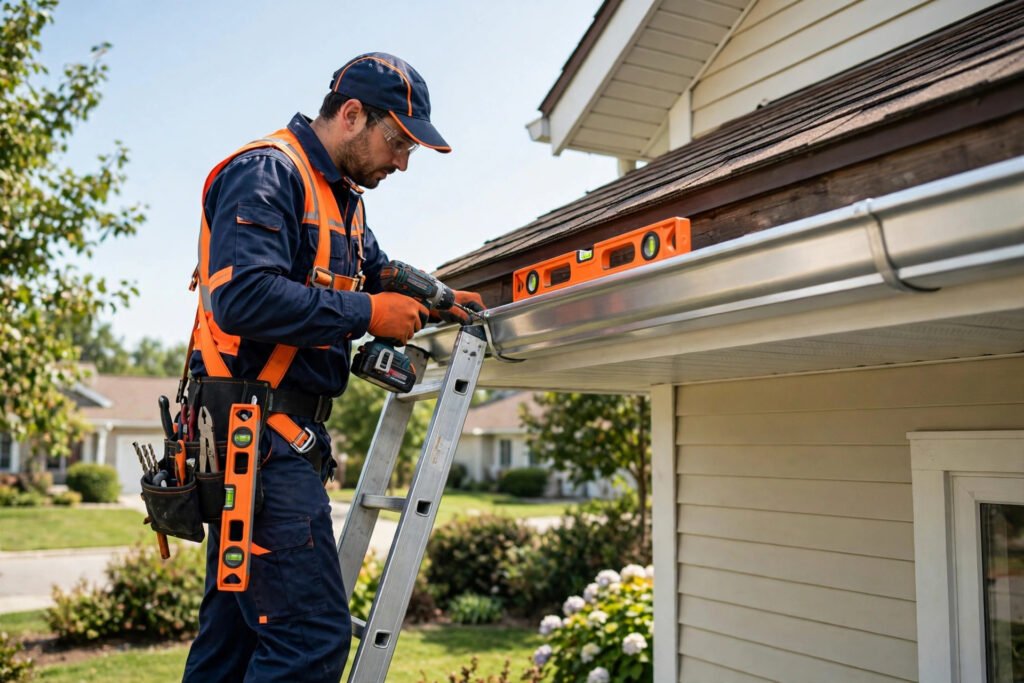
If rain pours off your roof in sheets, pools next to your foundation, or stains your siding every storm, your gutter installation cost is probably the first number you want — before you call anyone for a quote. In 2026, most homeowners pay $6 to $14 per linear foot installed for standard seamless aluminum gutters, with a typical whole-house job (150–200 linear feet of gutter plus downspouts) commonly landing between $1,200 and $3,200. Vinyl and sectional systems cost less, while steel, zinc, and copper can push a full installation to $4,000–$9,000 or more. This guide breaks down what each material and gutter style actually costs, what a complete quote should include, and how to tell a fair bid from one that leaves out the downspouts, hangers, and disposal you will end up paying for anyway.
The quick answer
Gutter installation cost comes down to four things: the material, the total linear feet, how many corners and downspouts your roofline needs, and how hard your house is to work on. A single-story ranch with long, straight runs is the cheapest common job. A two- or three-story house with a cut-up roofline, lots of miters, and premium copper gutters costs three to five times as much — and sometimes that extra spend is justified by climate, roof size, and how long you plan to stay, and sometimes it is pure upsell.
| Gutter material | Installed cost per linear foot (2026) |
|---|---|
| Vinyl (sectional) | $4 – $8 |
| Aluminum, sectional | $5 – $10 |
| Aluminum, seamless (most common) | $6 – $14 |
| Galvanized steel | $9 – $18 |
| Stainless steel | $15 – $28 |
| Zinc | $18 – $32 |
| Copper | $25 – $45 |
Want a ballpark for your whole project before you talk to an installer? Run your numbers through our free Project Cost Calculator — enter your project size and finish level, and you’ll get a realistic low–high range in seconds to bring to every quote appointment.
Costs in this guide are national ranges for planning purposes. Your local quotes will vary by region, materials, house height, and scope — always get at least three written bids on the same scope before you hire.
Gutter installation cost by house and roofline
Per-foot pricing only helps if you know roughly how many feet you have. Most single-family homes need 120 to 220 linear feet of gutter, plus one downspout roughly every 30–40 feet of run. Measure along the eaves where water actually sheds — not every edge of the roof needs a gutter, and valleys and lower roofs change the count.
| Home profile | Approx. gutter needed | Seamless aluminum installed (2026) |
|---|---|---|
| Small single-story, ~1,000 sq ft | 100 – 130 ft | $800 – $1,800 |
| Average single-story, ~1,500 sq ft | 140 – 170 ft | $1,100 – $2,400 |
| Two-story, ~2,000 sq ft | 160 – 200 ft | $1,300 – $2,900 |
| Large two-story, ~2,500 sq ft | 190 – 240 ft | $1,600 – $3,500 |
| Large or complex roofline, 3,000+ sq ft | 240 – 320 ft | $2,100 – $4,800 |
Downspouts are usually priced into a complete bid, but confirm it: priced separately, expect roughly $75–$200 per downspout installed depending on height and material. Corners (miters), end caps, hangers, and sealant are the small parts that separate a complete quote from a low per-foot teaser.
Seamless vs. sectional gutters: the decision that affects leaks most
This is the choice homeowners hear about most — and the one that explains much of the gap between a $900 quote and a $2,200 quote for the same house.
Seamless gutters are roll-formed on site from a continuous coil to the exact length of each run, so the only joints are at corners and downspouts. Fewer joints means fewer leak points and a cleaner look. They cost more per foot than sectional systems and require a professional crew with a gutter machine — they are not a DIY product — but for most homeowners they are the best value over a 20-year life.
Sectional gutters come in 10-foot pieces joined with connectors and sealant, sold at home centers in vinyl and aluminum. They are cheaper up front and genuinely DIY-able on a single-story house, but every joint is a future drip, and sealant typically needs renewal every few years. On a long run, that is a lot of joints to maintain.
A trustworthy installer will measure each run, show you where the joints, corners, and downspouts will fall, and explain which system they are quoting. Be cautious with a pitch that quotes a seamless price but installs sectional pieces, or the reverse confusion in the paperwork. Our 12-step contractor hiring checklist walks through how to verify claims like this before you sign.
Size and style: 5-inch, 6-inch, K-style, and half-round
5-inch K-style is the residential standard in most of the US. The flat back fits the fascia, the shaped front looks like crown molding, and it handles the roof runoff of a typical house in moderate rainfall well.
6-inch K-style holds roughly 40–50% more water than 5-inch and is the right upgrade for steep roofs, large roof planes, metal roofs (which shed water fast), and regions with intense downpours. Expect roughly $1–$3 more per linear foot than 5-inch, plus larger 3×4-inch downspouts instead of 2×3-inch. If your current gutters overflow in heavy rain rather than clog, oversizing is often the real fix — not another cleaning.
Half-round gutters are the traditional choice on historic, Mediterranean, and high-end homes. They look distinctive and clog a little less readily, but they hold less water for their width, need special brackets, and typically cost 30–80% more than K-style in the same material.
Fascia-style and custom box gutters are less common, often integrated into the roof edge, and priced as specialty work. Get them quoted separately and ask who fabricates replacement parts if a section is damaged in ten years.
What a complete quote should include
Gutter quotes are where line items quietly disappear — a low per-foot number that excludes everything that makes the system work. A complete written quote should spell out:
- Exact material and thickness: for aluminum, the gauge matters — .032-inch is the stronger standard; thinner .027-inch material dents more easily and is common in budget bids. The gauge should be in writing.
- Gutter size and profile: 5-inch or 6-inch, K-style or half-round, and the downspout size to match.
- Total linear feet, by run: measured lengths for each eave, not one rounded house total.
- Downspouts: how many, where they discharge, and whether extensions or splash blocks are included to carry water away from the foundation.
- Hangers and spacing: hidden hangers with screws are the modern standard, typically every 24 inches (closer in snow country); old spike-and-ferrule systems loosen over time. Hanger type and spacing should be named.
- Corners, end caps, and sealant: counted and included, not billed as surprises.
- Old gutter removal and disposal: included or priced separately.
- Fascia condition: who repairs rotted fascia board if it is found once the old gutters come off, and at what rate. Gutters cannot hold on rotten wood, and this is the most common legitimate add-on — it should be priced as a rate in advance, not discovered as a blank check.
- Pitch and drainage plan: gutters should slope gently toward downspouts (roughly 1/4 inch per 10 feet). A level-looking install that ponds water is a defect, not a style choice.
- Warranty, split in two: the material warranty and the installer’s workmanship warranty, with lengths for each, including how long joints are guaranteed leak-free.
- Payment schedule: a modest deposit is normal for custom seamless work; a demand for most of the money up front is not.
If a quote is just a per-foot number with none of this in writing, do not sign it. Compare it against at least two other itemized bids on the same material, gauge, size, and scope.
Gutter guards, screens, and other add-ons
Gutter guards and covers ($7–$25 per linear foot installed, depending on type) are the most common upsell. Basic screens sit at the low end; micro-mesh and solid surface-tension covers sit at the high end, and on a whole house they can cost as much as the gutters themselves. Guards reduce how often you clean — they do not eliminate maintenance, and no honest installer will promise “never clean again.” They make the most sense under heavy tree cover, on houses where ladder access is dangerous, and for homeowners who would otherwise pay for cleaning two to four times a year. If your roof has little tree cover, guards are often money better spent elsewhere.
Other common add-ons: heat cable in ice-dam climates, rain chains in place of a downspout, underground drain extensions to daylight or a dry well (priced by the foot and highly site-specific), and splash guards at inside valleys where roof water overshoots the gutter. Each should be a separate line you can decline without changing the base price.
Bundling matters here too: if you are already planning a new roof, sequence the gutters after the roof — roof tear-off is rough on old gutters, and new gutters installed before a re-roof often have to come off again. Coordinating the two projects usually saves a second removal fee.
Replacement vs. repair vs. cleaning: which do you actually need?
Not every failing gutter system needs full replacement, and a trustworthy installer will tell you which tier yours is really in.
Cleaning ($125–$300 for a typical house, more for height and heavy debris) is the right spend when gutters are sound but full. Overflow during rain is a clog symptom first and a size symptom second — clean and check the pitch before you replace.
Repair ($150–$600 for typical jobs) makes sense for a leaking corner, a pulled-away section, one damaged downspout, or re-pitching a short run. Re-sealing joints, replacing hangers, and patching small holes are often work a handyman can handle on a single-story house; two-story and roof-edge work belongs with a gutter or roofing pro with the right ladders and safety gear.
Full replacement is the right call when gutters are rusted through, cracked in multiple places, pulling away along whole runs because the fascia behind them is rotted, or chronically overflowing because they are undersized for the roof. Replacement is also your one practical chance to move to seamless, step up to 6-inch, and fix downspout placement — changes that are cheap during a full install and awkward as retrofits.
What drives the price up (or down)
- House height and access. A single-story ranch is ladder work; a three-story house on a slope may need scaffolding or a lift, and the labor price reflects it. Steep yards, tight side yards, and landscaping tight to the foundation all slow crews down.
- Roofline complexity. Every corner is a miter, every level change is a transition, and hip roofs need far more gutter than a simple gable roof of the same square footage. Complexity, not just house size, drives the foot count.
- Material and gauge. Copper and zinc are premium metals with premium labor — soldering and specialty handling are part of the price. Within aluminum, stepping from .027 to .032 gauge adds a modest amount per foot and buys real dent resistance against ladders and hail.
- Old system removal. Steel and cast systems are heavy to remove; disposal fees vary by area. Confirm whether removal is in the bid.
- Fascia and soffit repair. Rot found behind old gutters is common on houses whose gutters leaked for years. Priced per linear foot of board replaced, it is legitimate when shown to you — ask for photos before authorizing a large run.
- Region and season. Labor in high-cost metros can run 20–35% above national averages. Fall is peak season in leaf country; late winter and early spring installs are sometimes priced more flexibly, weather permitting.
- Bundling exterior work. If painters are already coming for exterior painting, sequence gutters and paint so neither crew damages the other’s fresh work — gutters usually come off for good painting, which can share a removal cost.
How long does gutter installation take — and how long do gutters last?
Once materials are on site, a professional crew typically installs a full house of seamless gutters in half a day to one day; complex rooflines, premium metals, and fascia repair can extend that to two days. Sectional DIY installs take most homeowners a full weekend for a single story, including the ladder moves most people underestimate.
Lifespans by material, with joints maintained: vinyl 15–20 years (it gets brittle in cold and UV), aluminum 20–30 years, galvanized steel 20–25 years before rust becomes the story, and copper and zinc 40–60+ years. The habits that get a system there are simple: clean or inspect twice a year (after leaf fall and in spring), re-seal sectional joints when drips appear, keep downspout outlets clear, and make sure water discharges well away from the foundation. Most premature failures trace back to bad pitch, spaced-too-far hangers sagging under snow or debris weight, and leaks left dripping onto fascia until the wood rotted — which is why hanger spacing and pitch in your quote matter more than a small difference in per-foot price.
Frequently asked questions
How much does gutter installation cost for an average house? For a typical home needing 150–200 linear feet, most homeowners pay $1,200–$3,200 for seamless aluminum including downspouts, removal of the old system, and disposal. Vinyl sectional work can come in under $1,000, while copper on the same house can exceed $6,000. Run your exact footage through our Project Cost Calculator for a tighter range before you collect bids.
Are seamless gutters worth the extra cost? For most homeowners who plan to stay five years or more, yes. The premium over sectional is modest, and eliminating a joint every 10 feet removes the most common leak and maintenance point in the system. Sectional still makes sense for a small, simple, single-story run you are comfortable maintaining yourself.
Should I get 5-inch or 6-inch gutters? Choose 6-inch if your roof is steep, your roof planes are large, you have a metal roof, you live where downpours are intense, or your current 5-inch gutters overflow when clean. The modest per-foot premium is far cheaper than foundation and siding damage from chronic overflow, and 6-inch systems need the larger 3×4-inch downspouts to deliver the benefit.
Do I need a permit to install gutters? Usually no — like-for-like gutter replacement rarely needs a permit. Rules vary, and permits or HOA approvals can apply when you change drainage patterns, connect to a municipal storm system, or work in a historic district. Your installer should know the local rule and name who handles any approval in the contract.
Can I install gutters myself? Sectional vinyl or aluminum on a single-story house is a reasonable project for a confident DIYer with a helper — gutters must be pitched, sealed, and hung level enough to drain, and long runs are awkward on ladders. Seamless requires a forming machine, copper requires soldering skill, and any two-story work carries real fall risk. Price your time and the ladder risk honestly against the labor portion of a pro bid.
Why is one gutter quote double another for the same house? Usually the material gauge, the gutter size, whether downspouts and removal are included, and whether guards were quietly added. Line the bids up item by item — and be wary of the classic pressure patterns: a price far below every other bid, a demand for most of the money before work starts, or a “today only” discount. Those are textbook examples in our guide to contractor scams and red flags.
Prices are national averages for planning purposes; your local quotes will vary by region, materials, and scope. Always get at least three written bids on the same scope before you hire.