
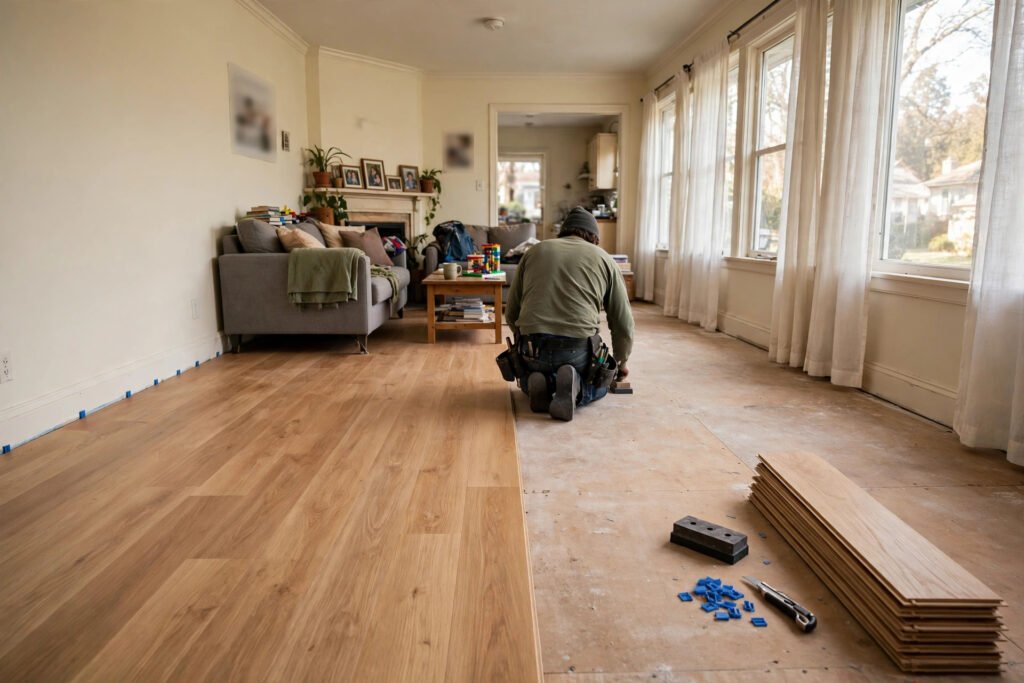
New floors change how a whole house feels — and they’re one of the most common projects homeowners price before calling a contractor. The catch is that flooring quotes bundle material, underlayment, removal and labor together, so a $4-per-foot bid and a $9-per-foot bid may not be selling the same job. This guide breaks down what each flooring type actually costs installed in 2026, what a complete quote should include, and where the money really goes.
The quick answer
Most homeowners pay $6–$18 per square foot installed for new flooring, depending on material. Budget-friendly laminate and luxury vinyl plank (LVP) land at $4–$10 per sq ft installed, mid-range engineered hardwood and tile at $8–$15, and solid hardwood at $12–$25 for premium species and wide planks. A typical 1,000 sq ft project runs $6,000–$15,000 all-in once removal, underlayment and trim are counted.
| Flooring type | Installed cost per sq ft (2026) |
|---|---|
| Laminate | $4 – $8 |
| Luxury vinyl plank (LVP) | $5 – $10 |
| Sheet vinyl | $3 – $7 |
| Engineered hardwood | $8 – $15 |
| Solid hardwood | $9 – $18 (premium $18 – $25) |
| Ceramic / porcelain tile | $8 – $15 |
| Natural stone tile | $12 – $25 |
| Carpet (for comparison) | $3 – $8 |
Want a number for your exact rooms? Run it through our free Project Cost Calculator — pick flooring, enter your square footage and finish level, and you’ll get a realistic low–high range in seconds.
Costs by material
Laminate ($4–$8/sq ft installed). The budget workhorse. Modern laminate looks convincingly like wood, resists scratches well, and installs fast because it floats over underlayment. It is not a good fit for full bathrooms — water is its weakness, though water-resistant lines are improving.
Luxury vinyl plank ($5–$10/sq ft installed). The most popular choice in 2026 for kitchens, bathrooms and basements. Fully waterproof in most product lines, comfortable underfoot, and durable with kids and pets. Wear-layer thickness (12–20+ mil) is the number that separates a 5-year floor from a 20-year floor.
Engineered hardwood ($8–$15/sq ft installed). A real-wood veneer over a stable plywood core. It handles humidity better than solid wood, can go over concrete, and premium lines can be refinished once or twice. Looks and feels like solid hardwood because the top layer is.
Solid hardwood ($9–$18/sq ft installed; premium $18–$25). The long-life option — it can be sanded and refinished for decades. Red and white oak dominate the mid-range; wide-plank, rift-sawn and exotic species push into premium territory. Not recommended below grade or over radiant heat unless the manufacturer allows it.
Tile ($8–$15/sq ft installed; stone $12–$25). Ceramic and porcelain are the durable, waterproof standard for bathrooms and entries. Labor is the big cost — tile is slow, skilled work, and large-format or patterned layouts cost more. Natural stone adds material cost plus sealing and maintenance.
What a complete quote should include
Flooring quotes are where line items quietly disappear. A complete written quote should spell out:
- Material: exact product name, thickness/wear layer, and whether the quoted price includes 10% overage for cuts and waste (it should).
- Old floor removal and disposal: $1.50–$3.50 per sq ft if it’s not already included — ask explicitly, because this is the most common surprise charge.
- Subfloor prep: leveling compound, underlayment, moisture barrier (essential over concrete), and any plywood repairs, priced separately if needed.
- Trim and transitions: baseboards, quarter-round, and transition strips between rooms and materials. Reusing old baseboard vs. replacing it changes the price.
- Stairs: quoted per step, not per square foot — typically $75–$200 per step for wood or LVP, more for tile.
- Furniture and appliances: who moves them, and whether toilet removal/reset for bathroom tile is included (or left to your plumber).
- Timeline and warranty: install days, acclimation time for wood products (real hardwood needs 3–7 days in the home before install), and the installer’s workmanship warranty.
If a quote is just a per-foot number with none of this in writing, use our 12-step contractor hiring checklist before you sign — it covers exactly what to verify.
What drives the price up (or down)
- Room shape and layout. Open rectangles are cheap; hallways, closets, diagonal or herringbone patterns and lots of doorways add cutting labor fast.
- Subfloor condition. Wavy, squeaky or water-damaged subfloors must be fixed first. This is legitimate added cost — but get it in writing after the old floor comes up, with photos.
- Removal surprises. Tile and glued-down floors are the slowest to remove. Multiple layered old floors (common in older homes) add disposal weight and time.
- Material tier. With LVP and laminate, an extra $1–$2 per sq ft of material buys a much thicker wear layer — usually the best value upgrade in the whole project.
- DIY-ing the edges. Homeowners often save 10–20% by removing the old floor, moving furniture and handling baseboards themselves, while leaving the install to the pro. A single bedroom of click-lock LVP is a reasonable DIY; tile showers and site-finished hardwood are not — that’s where a handyman or flooring specialist earns their rate.
Flooring contractor or big-box installer?
Retail chains sub the work to local crews — sometimes excellent, sometimes the lowest bidder, and you won’t know which until install day. An independent flooring contractor shows you their own past work and warranties it directly. Either way, watch for the classic warning signs in our guide to contractor scams and red flags: a quote far below every other bid, pressure to pay in full up front, or “leftover material from another job” offered at a steep discount.
Ready to compare real quotes? A local contractor matching service can line up several flooring installers to bid on the same written scope and product — the fastest way to find the fair price for your rooms.
Frequently asked questions
How much does it cost to floor a 1,000 sq ft area?
Most homeowners pay $6,000–$15,000 installed: roughly $4,000–$8,000 for laminate, $5,000–$10,000 for LVP, $8,000–$15,000 for engineered wood or tile, and $9,000–$18,000+ for solid hardwood, including removal and trim.
What is the cheapest flooring that still looks good?
Laminate and mid-grade LVP. LVP at $5–$10 per sq ft installed is the value sweet spot for most homes because it’s waterproof and wears well; laminate is slightly cheaper but should stay out of wet areas.
How long does flooring installation take?
A pro crew typically installs 300–500 sq ft per day for floating floors (laminate/LVP), less for nail-down hardwood, and tile runs slower still because of setting and grouting days. A 1,000 sq ft floating-floor project is usually 2–4 working days once materials are acclimated and on site.
Should I buy the flooring myself?
You can, and sales can save real money — but confirm the installer’s warranty still covers the install with owner-supplied material, order 10% extra for waste, and have it on site and acclimated before the crew arrives. Many contractors will not warranty products they didn’t supply.
Prices are national averages for planning purposes; your local quotes will vary. Always get at least three written bids on the same scope before you hire.