
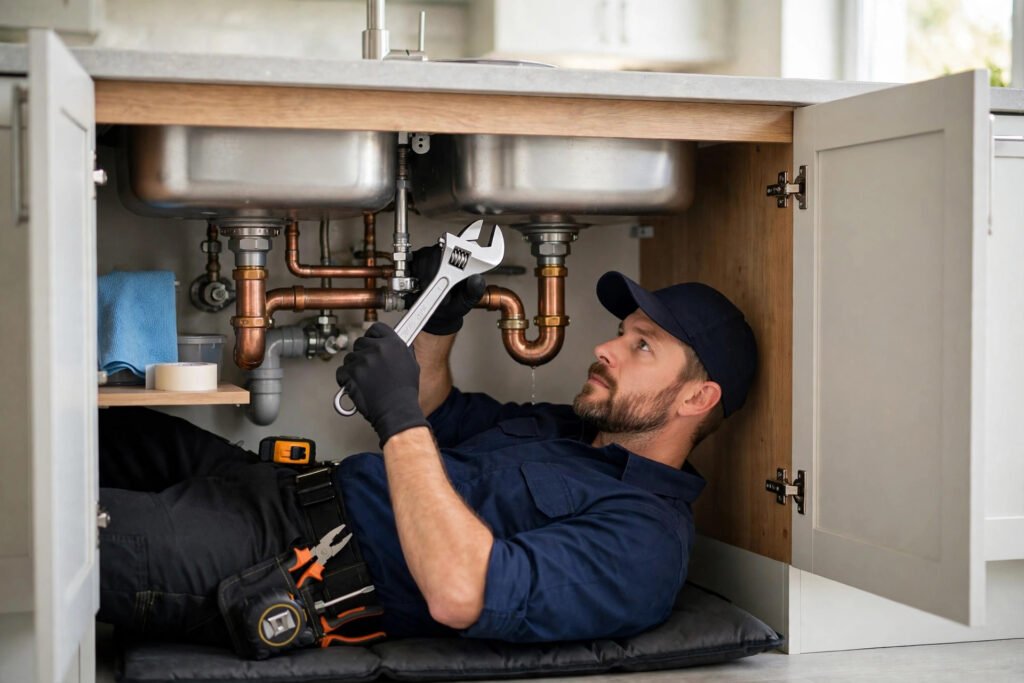
In 2026, most US plumbers charge $75 to $200 per hour, with a national average around $100 to $125 per hour for a licensed journeyman during regular business hours. Many jobs are quoted as a flat rate instead of hourly, and common repairs range from about $175 for a simple drain clog to $1,200 or more for a water heater installation. Every figure here is an estimate based on 2025–2026 national ranges — prices vary significantly by region, company, and the specifics of your home.
Plumber Hourly Rates Explained
Hourly pricing is most common for troubleshooting, open-ended repairs, and work where the scope is unclear until walls or fixtures are opened up.
| Plumber type | Typical hourly rate |
|---|---|
| Apprentice / handyman-level | $45 – $85 |
| Licensed journeyman plumber | $75 – $150 |
| Master plumber | $120 – $200+ |
| Large franchise company (any level) | $100 – $200 |
You are not only paying for time. The rate covers licensing, insurance, a stocked truck, tools, travel, and the experience to diagnose a problem once instead of guessing twice. A master plumber who finds a leak in 20 minutes can be cheaper overall than a cheaper hourly rate billed for three hours of trial and error.
Trip Fees, Service Calls, and Minimums
Expect a trip or service-call fee of $50 to $150 just to get a plumber to your door and diagnose the problem. Some companies waive or credit that fee if you approve the repair; others treat it as separate. Ask before you book, not after the invoice arrives.
Most plumbers also have a one-hour minimum, even for a 15-minute fix. Flat-rate companies skip the clock entirely: they quote one price for the whole job from a standard price book before work begins. Neither model is automatically better — flat rate protects you on a job that runs long, while hourly can be cheaper for genuinely simple work.
Common Plumbing Job Prices
These flat-rate ranges cover the jobs homeowners request most, including parts and labor for typical installations:
| Job | Typical total cost (2026 estimate) |
|---|---|
| Drain clog (single drain, snaking) | $175 – $350 |
| Main line clog / hydro-jetting | $350 – $800 |
| Toilet repair (fill valve, flapper, seals) | $150 – $350 |
| Toilet replacement (standard model) | $350 – $700 |
| Faucet replacement | $250 – $600 |
| Leak repair (accessible pipe) | $250 – $650 |
| Water heater install (40–50 gal, tank) | $1,300 – $2,800 |
| Tankless water heater install | $3,000 – $5,500 |
| Garbage disposal replacement | $250 – $550 |
| Repiping a home (per fixture / whole house) | $400 – $650 per fixture / $4,500 – $15,000+ whole house |
| Sump pump replacement | $450 – $1,100 |
Notice how wide some ranges are. A water heater swap in the same location with the same venting is a half-day job; moving it, upsizing it, or bringing venting and gas lines up to current code can double the price. Repiping varies even more with home size, number of bathrooms, wall access, and whether drywall repair is included. For big-ticket items, the only meaningful number is a written quote for your house — see our 12-step checklist for how to compare them safely.
Emergency and After-Hours Premiums
Plumbing emergencies do not respect business hours, and pricing reflects that. For nights, weekends, and holidays, expect:
- 1.5x to 2x the standard hourly rate, or a flat emergency fee of $150 to $350 on top of the repair
- Higher trip fees for immediate dispatch
A burst pipe flooding a room justifies the premium. A slow drip under a sink usually does not. If the problem can safely wait until morning — shut off the water to that fixture, or the whole house if needed — you can often save $150 or more by booking a regular slot. Every homeowner should know where their main water shut-off valve is before an emergency, not during one.
Why Quotes for the Same Job Differ So Much
Homeowners routinely see a $300 quote and a $900 quote for what sounds like the same repair. Legitimate reasons include:
- Access: a leak above a finished ceiling costs more than one in an open basement
- Parts quality: builder-grade vs. name-brand fixtures and valves
- Code work: older homes may need shut-off valves, expansion tanks, or venting updates added
- Warranty: established companies often warranty labor for 1–2 years; the cheapest quote often has no warranty at all
- Overhead: a one-truck independent and a 40-truck franchise have very different cost structures
Ask each plumber to itemize parts, labor, and warranty in writing. Comparing itemized quotes is how you tell a fair higher price from a padded one. If you want several local quotes without calling around all day, a matching service can help.
How to Avoid Overpaying a Plumber
- Describe the problem precisely on the phone — fixture, location, when it started, photos if possible. Better information means a more accurate quote and the right parts on the truck.
- Ask the pricing model up front: hourly or flat rate, the trip fee, the minimum, and whether the trip fee is credited toward the repair.
- Get the quote in writing before work starts, with a “not to exceed” figure or a commitment to call you if the scope changes.
- Bundle small jobs. If a plumber is already at your house, fixing the second toilet or the dripping faucet in the same visit is far cheaper than a separate trip.
- Avoid authorizing open-ended exploratory work without a cap. Agree on a diagnosis fee and a decision point.
- Check the license and insurance for any job beyond a trivial fix, the same way you would for any contractor.
FAQ
Do plumbers give free estimates?
For defined jobs like a water heater replacement, many do. For diagnosis-based repairs, expect a service-call fee — the plumber’s time finding the problem is part of the work.
Is it cheaper to supply my own fixtures?
Sometimes, but many plumbers will not warranty parts they did not supply. If a faucet you bought fails, you may pay labor twice. Ask about the policy before buying.
Should I tip a plumber?
Tipping is not expected for standard service work. A good review and a referral mean more to most companies.
When does a plumbing job need a permit?
Water heater replacements, repiping, and new drain or gas work require permits in most jurisdictions. Simple like-for-like repairs usually do not. A licensed plumber should know and tell you.
The Bottom Line
Plan on $75 to $200 per hour for a licensed plumber in 2026, plus a trip fee, and use the job table above to sanity-check any flat-rate quote. The biggest savings come from avoiding emergency calls for non-emergencies, bundling small fixes into one visit, and getting the scope in writing before anyone picks up a wrench. For any job over a few hundred dollars, compare at least three quotes before you hire — the spread between them is often the largest discount available.