
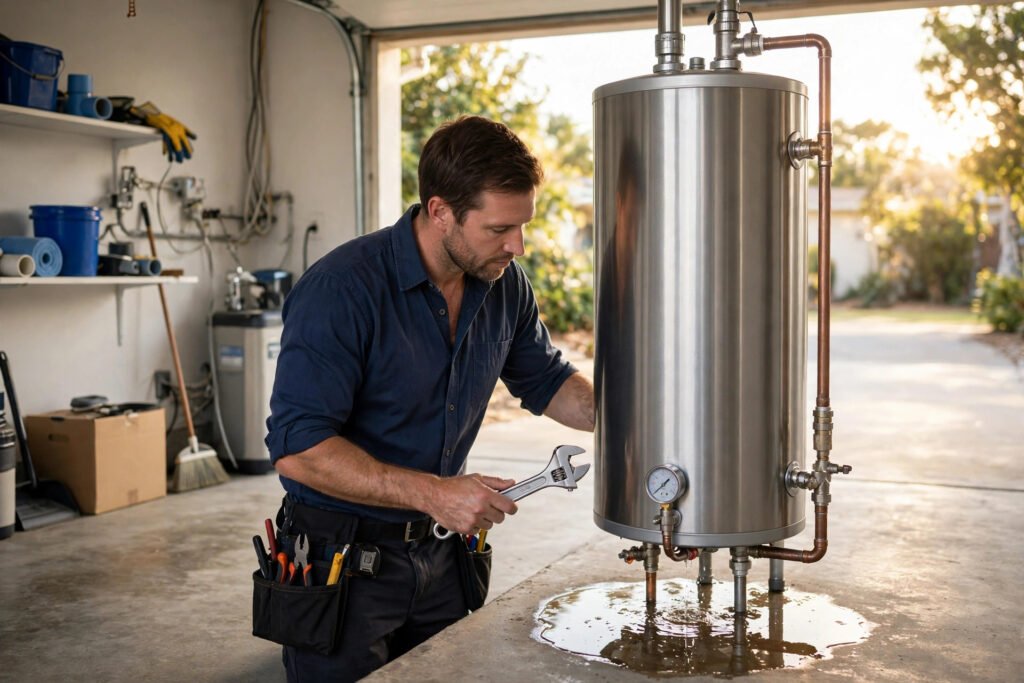
The shower goes lukewarm halfway through, there is a puddle spreading under the tank in the garage, and a plumber on the phone is asking the question you cannot answer yet: do you want me to fix it, or replace it? That decision — made under pressure, with no hot water in the house — is where homeowners lose the most money on this appliance. Your water heater replacement cost only makes sense when you compare it honestly against the repair in front of you, the age of the tank, and how much life a repair actually buys. This guide walks through that decision the way a good plumber should: symptom first, age second, math third. No panic, no upsell.
The 50 percent rule, and why age changes it
Plumbers use a rough rule of thumb, and it is worth learning before anyone quotes you anything: if a repair costs more than 50 percent of a new, installed unit — and the heater is more than halfway through its expected life — replace it. Either condition alone is a judgment call. Both together are close to automatic.
Expected life, for planning purposes:
- Standard tank (gas or electric): 8–12 years
- Tankless: 15–20 years, with regular descaling
- Heat pump (hybrid) water heater: 10–15 years
Here is why the math tilts so fast. A $450 repair on a 4-year-old tank buys you, on average, another 5–7 years of service — that is money well spent. The same $450 repair on a 10-year-old tank buys you maybe a year, because the tank itself — the one part that cannot be replaced — is corroding on its own schedule regardless of which valve or element you just paid to fix. You are not really choosing between $450 and a full replacement. You are choosing between $450 now plus a full replacement soon, or the full replacement once.
Find the age before you decide anything. The manufacturer’s label on the tank lists a serial number; the first digits usually encode the month and year of manufacture, and most manufacturers publish a decoder on their own site. If the label is gone, the home inspection report from when you bought the house often lists it.
What a new water heater replacement cost actually looks like in 2026
So the replacement side of the comparison is concrete, here are the planning ranges for a like-for-like swap — same fuel, similar size, no major relocation — installed by a licensed plumber:
| Replacement type (installed, 2026) | Typical range |
|---|---|
| 40–50 gallon gas tank | $1,400 – $2,600 |
| 40–50 gallon electric tank | $1,200 – $2,300 |
| Larger 65–75 gallon tank | $2,000 – $3,600 |
| Heat pump / hybrid electric | $2,500 – $4,500 before incentives |
| Tankless gas (including venting changes) | $3,000 – $5,500 |
| Tankless electric | $1,800 – $3,500, plus possible panel work |
The unit itself is often only a third to half of that total. The rest is labor, the permit in jurisdictions that require one, haul-away of the old tank, and the small parts — expansion tank, pan, shut-offs, venting — that a proper install includes and a bare-bones quote quietly leaves out. When one quote is $700 below the others, it is almost never because that plumber found cheaper water heaters. Something on that list is missing.
Get a rough installed figure for your size and fuel type from our free Project Cost Calculator before you call anyone, so the first quote you hear is measured against something. Costs vary by region, materials, and scope — high-cost metros and difficult access (attic installs, tight closets, long vent runs) push toward the top of every range above.
Symptom by symptom: what is worth fixing
Not every failure is the tank dying. Work through what you are actually seeing:
No hot water at all
On an electric heater this is most often a failed heating element or thermostat — a genuine repair, commonly $200–$450 installed, and worth doing at almost any age short of a leaking tank. On a gas unit, check the pilot and thermocouple first; a thermocouple is one of the cheapest fixes in plumbing. A failed gas control valve costs more ($300–$600) and starts to trigger the 50 percent rule on an older unit.
Water is hot, but runs out fast
Sediment. Years of mineral buildup insulate the bottom of the tank, shrink the usable volume, and make the burner or elements work harder — the popping and rumbling sounds are steam pockets in that sediment layer. A professional flush runs roughly $150–$300. On a mid-life tank it restores real capacity. On a tank that has never been flushed in ten years, be warned: the sediment may be the only thing sealing small corrosion points, and flushing can occasionally reveal a leak that ends the conversation. A plumber who mentions that risk before flushing is being honest, not evasive.
Rusty or discolored hot water
Run the cold tap. If cold is clear and hot is rusty, corrosion is inside your tank or the anode rod — the sacrificial rod designed to corrode instead of the tank lining — is spent. An anode rod replacement is about $250–$500 and can add years to a tank whose glass lining is still intact. If rust returns within months, the lining itself has failed. There is no repair for that. Replace.
Leaks — location is everything
- Leaking from a valve, fitting, or the temperature-and-pressure relief line: often repairable, $150–$400, and the T&P valve itself is a safety device worth replacing on schedule rather than after it sticks.
- Leaking from the tank body, the base seam, or multiple spots: the tank is done. No patch, sealant, or part fixes a corroded pressure vessel, and any quote to “repair” a tank-body leak should end that conversation. Shut off the water and power or gas, drain what you can, and move straight to replacement quotes.
Strange noises without other symptoms
Popping and rumbling alone, on a heater under eight years old with no rust and no leaks, is a flush-and-monitor situation, not a replacement trigger. Banging from pipes is a different problem — water hammer — and belongs to the plumbing system, not the heater.
The costs people forget to add to “just repair it”
A repair quote is a single number. The real cost of keeping an old heater has footnotes:
- Energy waste. A sediment-choked, late-life tank can use noticeably more gas or electricity to deliver the same showers. The penalty is not dramatic month to month, which is exactly why it never gets added up across the two extra years a repair bought.
- Water damage risk. Tank failures are rarely polite drips. A failed tank in an attic, closet, or finished basement can release its full contents plus the incoming supply until someone shuts it off. If your heater sits anywhere above finished space and is past year ten, the replacement argument is partly an insurance argument — and a drain pan with a leak alarm, roughly $30–$80 in parts, is cheap mitigation either way.
- Repeat service calls. Two $350 repairs fourteen months apart is a $700 down payment on a heater you still had to replace. Keep every invoice; the running total is the number that matters, and it is the number nobody volunteers.
- The emergency premium. A planned replacement, quoted by three plumbers on a Tuesday, costs less than a desperate one accepted at 9 p.m. on a Sunday. If your tank is 11 years old and working, the cheapest replacement you will ever buy is the one you schedule before it fails.
That last point is the strongest argument in this guide: the best time to shop for a replacement is while you still have hot water. Use our 12-step contractor hiring checklist to line up quotes calmly, and compare what each plumber charges per hour against our plumber cost guide so a “deal” on the unit is not quietly recovered in labor.
If you replace: four decisions that change the price
Like-for-like vs. switching type. Swapping a tank for the same fuel and size is the cheapest install. Switching to tankless adds venting, gas-line, or electrical work; switching to a heat pump model adds space and condensate requirements but can qualify for federal and utility incentives that change the math substantially. Get both quotes itemized — never compare a bare tank quote against a fully-loaded tankless quote.
Size honestly. A 40-gallon tank that served two people struggles with five. Recovery rate matters as much as capacity. But oversizing a tank you then heat around the clock wastes money too — tell the plumber your actual household and fixture count, not the number you think sounds safe.
Ask what the install includes. Permit, expansion tank, drain pan, new shut-off valves, haul-away, and disposal fees should be named in writing. This is also where our guide to contractor scams and red flags applies directly: pressure to decide “today only,” a quote with no line items, and a large cash deposit up front are the classic patterns, and a no-hot-water emergency is exactly when they get used.
Check the warranty split. Tank warranty (6, 9, or 12 years is typical) and labor warranty are separate things. A longer tank warranty often reflects a larger anode rod and better lining — it is one of the few upgrades with a straightforward payoff on a tank you plan to keep.
A short decision summary you can use on the phone
- Under 6 years old + a part failure (element, thermostat, thermocouple, valve): repair, almost always.
- 6–10 years old + a repair under $400 + no rust, no tank leaks: repair, and start a replacement fund.
- Over 10 years old + any repair over $400–$500: replace, and use the repair money as part of the install budget.
- Any age + tank-body leak or recurring rust: replace. There is no second option to price.
- Tankless over 12 years old + heat-exchanger failure: replace — the heat exchanger is the expensive core of the unit, and its failure late in life fails the 50 percent rule decisively.
When you have a live quote in hand, sanity-check the total once more in the Project Cost Calculator — it takes two minutes and it is much easier to question a number before you have signed for it than after the old tank is already on the truck.
Frequently asked questions
How long should a water heater last before replacement?
Most standard tanks last 8–12 years. Hard water, no flushing, and a spent anode rod pull that toward the short end; soft water and basic maintenance push past it. Tankless units commonly last 15–20 years with annual descaling.
Is it worth replacing a 10-year-old water heater that still works?
If it still heats well, shows no rust, and sits in a garage or unfinished basement, running it with a leak alarm and a replacement fund is reasonable. If it is over finished space, or showing any symptom in this guide, a planned replacement on your schedule is almost always cheaper than the emergency version of the same job.
Can I replace a water heater myself?
Some jurisdictions allow homeowner replacement with a permit and inspection; many require a licensed plumber, and gas connections, venting, and T&P discharge routing are safety-critical, inspected items. Manufacturer warranties may also require professional installation. Even confident DIYers should price a pro install first — for a straightforward like-for-like swap, the labor portion is often smaller than people expect. The same honest math we applied to DIY vs. hiring a pro for a deck applies here, with less room for error.
Why did my replacement quote include an expansion tank and a permit when another did not?
Because many local codes require both. The cheaper quote is usually not more efficient — it is quoting a different, smaller job. Ask each bidder to quote the same code-compliant scope, in writing, before comparing totals.
Prices are national averages for planning purposes; your local quotes will vary by region, materials, and scope. Always get at least three written bids on the same scope before you hire.
About this guide
This guide was researched and written by the Find Contractor editorial team for US homeowners. Cost figures are national planning ranges built by comparing multiple published 2025–2026 cost sources — they are not a quote. See How We Research Costs for our full method, and always get at least three written, itemized bids before you hire.