
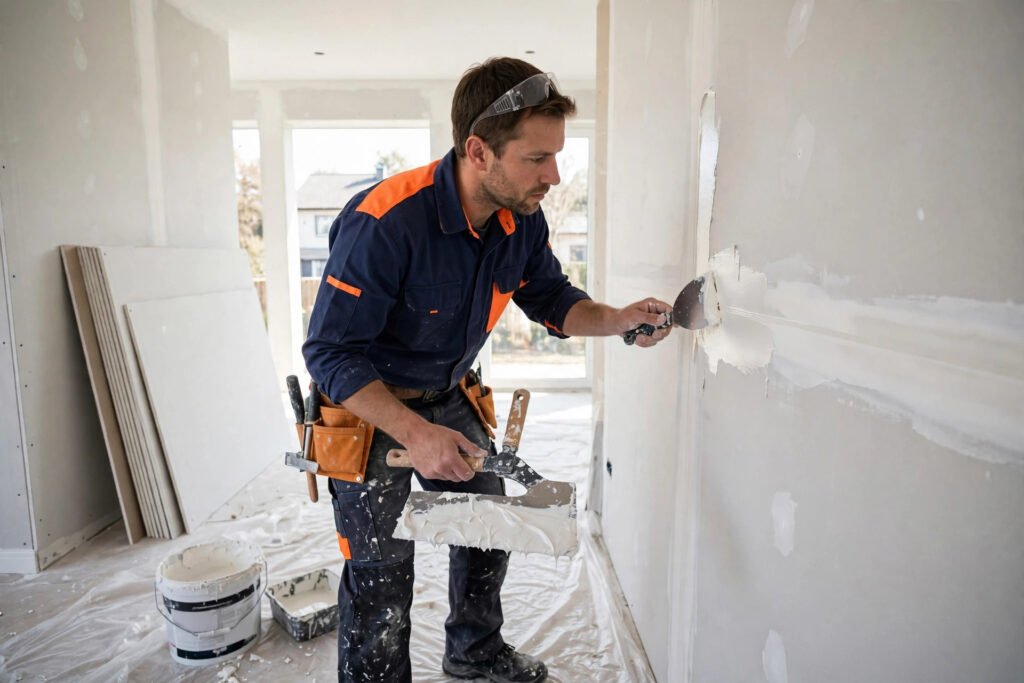
If your walls are cracked, water-stained, or still open studs after a remodel, your drywall cost is probably the first number you want — before you call anyone for a quote. In 2026, most homeowners pay $1.50 to $3.50 per square foot installed for standard drywall hung, taped, and finished ready for paint, with a typical single room (about 400–500 square feet of wall and ceiling surface) commonly landing between $800 and $2,000. Small repairs cost far less, while whole-house new construction, high ceilings, and smooth Level 5 finishes can push a project to $5,000–$15,000 or more. This guide breaks down what drywall actually costs per sheet, per room, and per square foot, what a complete quote should include, and how to tell a fair bid from one that leaves out the finishing, texture, and cleanup you will end up paying for anyway.
The quick answer
Drywall cost comes down to four things: how many square feet of board you need, the finish level you choose, how cut-up the rooms are, and whether old drywall has to come out first. A plain rectangular bedroom with 8-foot ceilings and a standard Level 4 finish is the cheapest common job. A vaulted great room, a basement with bulkheads and soffits, curved walls, and a glass-smooth Level 5 finish under glossy paint costs two to three times as much per foot — and sometimes that extra spend is justified by the light and the look you want, and sometimes it is pure upsell.
| Project | Typical installed cost (2026) |
|---|---|
| Drywall, per square foot of board (hang + finish) | $1.50 – $3.50 |
| Per sheet (4×8 ft, 32 sq ft) installed | $50 – $110 |
| Per sheet (4×12 ft, 48 sq ft) installed | $70 – $160 |
| Single room, 12×12 ft, walls only | $650 – $1,400 |
| Single room, 12×12 ft, walls + ceiling | $900 – $2,100 |
| Basement finishing, drywall portion (800 sq ft floor) | $3,500 – $8,500 |
| Garage, two-car, walls + ceiling | $2,200 – $4,800 |
| Whole house, new construction (2,000 sq ft floor) | $9,000 – $22,000 |
| Small repair / patch (single hole or crack) | $150 – $450 |
Want a ballpark for your whole project before you talk to an installer? Run your numbers through our free Project Cost Calculator — enter your project size and finish level, and you’ll get a realistic low–high range in seconds to bring to every quote appointment.
Costs in this guide are national ranges for planning purposes. Your local quotes will vary by region, materials, ceiling height, and scope — always get at least three written bids on the same scope before you hire.
Drywall cost per square foot, per sheet, and per room
Drywall is confusing because contractors quote it three different ways. Understanding all three stops you comparing a per-sheet material price at a home center with a finished per-foot bid from a pro — they are not the same job.
Per square foot of board ($1.50–$3.50 installed) is the figure to compare bids with. Note that this is square feet of drywall surface, not floor space. A 12×12-foot room with 8-foot ceilings has about 384 square feet of wall plus 144 square feet of ceiling — roughly 528 square feet of board, or about 3.7 times its floor area. Contractors who quote “per square foot” without saying which square foot are a red flag.
Per sheet helps you sanity-check materials. A standard 4×8-foot sheet of 1/2-inch drywall costs roughly $12–$22 for the board alone in 2026, depending on type and region. Installed and finished, that same sheet lands at $50–$110 because labor — hanging, taping, three coats of compound, and sanding — is most of the price of any drywall job.
| Drywall type | Board cost per 4×8 sheet (2026) | Where it is used |
|---|---|---|
| Standard 1/2-inch | $12 – $20 | Most walls |
| Lightweight 1/2-inch | $13 – $22 | Ceilings and large jobs; easier to lift |
| 5/8-inch fire-rated (Type X) | $16 – $26 | Garages, furnace rooms, code-required fire separation |
| Moisture-resistant (“green board”) | $16 – $25 | Bathrooms and laundry rooms, outside direct shower spray |
| Mold-resistant | $18 – $28 | Basements and humid climates |
| Cement / tile backer board | $14 – $24 (3×5 ft sheet) | Inside showers and behind tile — not a drywall substitute elsewhere |
| Sound-reducing drywall | $35 – $55 | Home theaters, bedrooms on shared walls, home offices |
Per room is how most homeowners actually budget. A standard bedroom walls-only job at Level 4 finish usually lands at $650–$1,400; add the ceiling and it rises to $900–$2,100. Bathrooms cost more per foot than bedrooms despite being smaller, because every pipe, outlet, and tile transition is a cut, and moisture-resistant board costs more.
Finish levels explained: the choice that moves the price most
This is the part of the quote most homeowners never see explained — and the one that explains much of the gap between a $1,200 quote and a $2,400 quote for the same room. Drywall finishing is rated in levels from 0 to 5.
Level 0–2 is unfinished to roughly taped. It is appropriate for temporary work, garages where appearance barely matters, and areas that will be covered by tile or paneling. No homeowner should accept these levels for a living space that will be painted.
Level 3 adds a heavier coat of compound and is meant for walls that will receive a heavy texture or heavy-grade wallcovering. It is not smooth enough for ordinary flat or eggshell paint — joints and fasteners will show through.
Level 4 is the residential standard. Joints and fasteners get three separate coats, sanded smooth, and the wall is ready for flat or low-sheen paint and light textures. When a quote just says “finished,” it should mean Level 4 — get that in writing.
Level 5 adds a thin skim coat over the entire surface, not just the joints. It is the right call under glossy or dark paint, in rooms with harsh side-lighting from large windows, and on ceilings that catch raking light. Expect roughly $0.40–$1.00 more per square foot than Level 4. If your room has a wall of windows, a trustworthy finisher will raise Level 5 before you discover the joint shadows yourself, after painting.
Texture is separate from finish level. Orange-peel and knockdown textures typically add $0.30–$1.00 per square foot, can hide minor imperfections (which is why they are popular in production homes), and are harder to patch invisibly later. Smooth walls cost more to finish well and show every future dent — an honest trade-off to choose with your eyes open.
What a complete quote should include
Drywall quotes are where line items quietly disappear — a low per-foot number that excludes everything that makes a wall paint-ready. A complete written quote should spell out:
- Board type and thickness: 1/2-inch standard, 5/8-inch Type X where code requires it, and moisture- or mold-resistant board where the room demands it — named in writing, not assumed.
- Total square feet of board, by room: measured wall and ceiling area, not just floor area, so you can compare bids sheet-for-sheet.
- Finish level: Level 4 or Level 5, stated explicitly, plus whether texture is included and which texture.
- Demolition and disposal: whether tear-out of old drywall is included and at what price. Removing old drywall typically adds $0.50–$1.50 per square foot, and plaster-and-lath in older homes costs more and is far messier.
- Corners, beads, and openings: corner bead, window and door wrapping, and cutouts for outlets, lights, and vents — counted and included.
- Insulation and framing fixes found on opening: who repairs a rotted stud or adds insulation if it is discovered once walls are open, and at what rate. This should be priced as a rate in advance, not discovered as a blank check.
- Priming: whether a drywall primer coat (PVA primer) is included or whether painting is a separate job. Fresh drywall must be primed before paint or the finish will flash — confirm who owns this step.
- Dust control and cleanup: sanding creates fine dust that travels through a whole house. The quote should say how openings will be sealed, whether dustless sanding equipment will be used, and who hauls away offcuts and old board.
- Schedule by stage: hanging, taping, each coat, and sanding happen on different days because compound must dry between coats. A realistic quote names the number of visits, not just a finish date.
- Warranty: workmanship warranty length in writing, including how nail pops and joint cracks in the first year are handled.
- Payment schedule: a modest deposit is normal on larger jobs; a demand for most of the money up front is not.
If a quote is just a per-foot number with none of this in writing, do not sign it. Compare it against at least two other itemized bids on the same board type, finish level, and scope, and use our 12-step contractor hiring checklist to verify licenses, insurance, and references before you choose.
Drywall repair cost: patches, cracks, and water damage
Not every drywall job is a room. Repair is its own pricing world, because small jobs carry trip and setup time that has nothing to do with square feet.
Small patch ($150–$450). A doorknob hole, a plumbing access cut, or a single dented corner. Many of these are work a handyman can handle in one visit — including the return trip for sanding and texture matching, which is the part DIY patches usually skip and why they stay visible.
Medium repair ($300–$900). Several holes, a cracked ceiling section, a leaking-pipe ceiling stain cut out and replaced, or a section of garage wall. Water-damaged drywall should be cut back to dry, sound board — painting over a stain with stain-blocking primer is fine for a dry, historic stain, but soft or crumbling board has to go.
Large repair ($800–$2,500+). A flooded basement’s bottom two feet (the standard “flood cut”), a burst-pipe ceiling across a room, or extensive cracking from settlement. If cracks keep returning in the same place, the cause — foundation movement, a truss lifting seasonally, a slow leak — has to be fixed first, or you will pay for the same repair every year.
Ceiling repair costs more than wall repair — typically 20–40% more for the same area — because the work is overhead, ceilings show every imperfection in raking light, and matching a textured ceiling invisibly is the hardest trick in the trade. Budget accordingly and ask to see a previous ceiling patch the contractor has done, in person if possible.
Replacement vs. repair: which do you actually need?
Repair makes sense when damage is isolated, the board around it is dry and sound, and the finish can be matched. One hole does not need a new wall.
Partial replacement — one wall, the bottom half of a basement, one ceiling — is the right call when damage is concentrated, mold is present in a limited area, or you are opening a wall anyway for plumbing or electrical work. If the wall is already open, upgrading insulation and adding sound board is cheap now and expensive later.
Full-room or full-house replacement is justified when the existing drywall is plaster-and-lath failing in multiple places, when smoke or long-term water damage has affected most surfaces, or during a gut remodel where the layout is changing anyway. In a gut remodel, drywall usually follows the rough plumbing, electrical, and inspection sequence — sequencing it before inspections is a classic beginner mistake that ends with inspectors asking for walls to be reopened.
Bundling matters here too: if you are already planning interior or exterior painting, sequence drywall first and painting last, with primer in between, so the painters are not working over sanding dust and the finishers are not patching around fresh paint.
What drives the price up (or down)
- Ceiling height and access. Eight-foot ceilings are ladder-and-stilt work. Vaulted, tray, and two-story ceilings need scaffolding or a lift, and the labor price reflects it. Stairwells are notoriously slow for the same reason.
- Room complexity. Every corner, soffit, bulkhead, arch, and closet is measuring, cutting, and bead work. A cut-up bathroom can cost more per foot than three plain bedrooms.
- Finish level and paint sheen. Level 5, smooth (untextured) surfaces, and glossy or dark paint all expose imperfections — each step up demands more coats and more sanding time.
- Old material removal. Plaster and lath, multiple layered boards, and water-damaged board are slow, heavy demolition. Confirm tear-out and disposal in writing.
- Board upgrades. Fire-rated, mold-resistant, and sound-reducing boards cost more per sheet, and sound board also needs special finishing care. They are worth it in the right rooms and wasted money in the wrong ones.
- Region and season. Labor in high-cost metros can run 20–35% above national averages. Drywall crews are busiest during spring and summer remodel season; winter scheduling is sometimes more flexible.
- Bundling with exterior and structural work. If crews are already on site for a concrete driveway or a gutter installation, that does not make drywall cheaper — different trade, different crew — but coordinating schedules so trades are not waiting on each other’s inspections saves real calendar time on a whole-house project.
How long does drywall take — and how long does it last?
Hanging is fast: a professional crew can board a typical room in a day. Finishing is not, because each coat of compound must dry before the next — usually three coats over three to five days, with sanding and priming after. A single room commonly takes four to seven working days from studs to paint-ready, spread across those drying windows. A whole house runs two to four weeks for the drywall phase. Any quote promising a large job hung, finished, and painted in two days is promising wet compound under paint.
Drywall itself lasts as long as the house if it stays dry. Its enemies are water, impact, and movement: keep plumbing leaks fixed promptly, use door stops where knobs meet walls, and expect a few nail pops and hairline joint cracks in a new installation’s first year as the house dries and settles — a good contractor includes a one-year touch-up visit for exactly this, in writing. Boards in a garage or basement that floods repeatedly are a recurring cost, not a one-time one, until the water problem itself is fixed.
Drywall vs. plaster vs. paneling: an honest comparison
- Drywall ($1.50–$3.50 per sq ft installed) is the modern standard: fastest to install, easiest to repair, and the surface every painter and buyer expects. Its weakness is impact and water — it dents and it soaks.
- Veneer plaster over blueboard ($3.50–$6.50 per sq ft installed) gives a harder, smoother, more durable surface with a craftsman feel, at roughly double the cost and with far fewer contractors offering it. Repairs need a plasterer, not a patch kit.
- Traditional three-coat plaster is now mostly a restoration trade for older and historic homes — beautiful and rock-hard, but the most expensive option and the slowest to cure.
- Wood paneling and shiplap ($3–$10+ per sq ft installed, material-dependent) is an accent choice, not a whole-house wall system, and in many jurisdictions still needs a fire-rated backing behind it.
Whichever surface you choose, be wary of the classic pressure patterns — a quote far below every other bid, a demand for most of the money before work starts, or a “today only” discount. Those are textbook examples in our guide to contractor scams and red flags.
Frequently asked questions
How much does drywall cost for a 12×12 room? For a typical 12×12-foot room with 8-foot ceilings, most homeowners pay $650–$1,400 for walls only and $900–$2,100 for walls plus ceiling, hung and finished to Level 4 ready for primer. Texture, Level 5 finish, and tear-out of old material add to that range. Run your exact dimensions through our Project Cost Calculator for a tighter range before you collect bids.
How many sheets of drywall do I need? Divide the total wall and ceiling surface area by 32 for 4×8 sheets (or 48 for 4×12 sheets), then add 10–15% for cuts and waste. A 12×12 room with ceiling is about 528 square feet of surface — roughly 17 sheets of 4×8, or 19–20 sheets once waste is included. Your contractor’s measured count, by room, should be in the quote.
Should I hang drywall myself? Hanging a few sheets in a garage or a single straight wall is a reasonable project for a confident DIYer with a helper — sheets are heavy, awkward, and unforgiving overhead. Finishing is where DIY work usually shows: taping and coating to an invisible Level 4 takes practice, and the mistakes appear only after painting. A common middle path is to hang it yourself and hire a finisher — ask before you hang, because some finishers charge more to coat work they did not hang.
Do I need a permit for drywall? Like-for-like repair and patching usually needs no permit. New walls, basement and garage conversions, and fire-rated assemblies often do — and in a remodel, drywall must wait until rough plumbing and electrical inspections have passed. Rules vary by city. Your contractor should know the local rule and name who handles any permit in the contract.
Why is one drywall quote double another for the same room? Usually the finish level, whether tear-out and disposal are included, whether primer is in the price, and whether texture was quietly added or quietly left out. Line the bids up item by item — board type, square feet, finish level, and cleanup — before you decide the expensive one is overpriced or the cheap one is a bargain.
How do I know if water-damaged drywall must be replaced? If the board is soft, crumbling, swollen, sagging, or shows mold growth, it has to come out — cut back to dry, sound material and dry the cavity before closing it. A dry, firm board with only a historic stain can usually be sealed with stain-blocking primer and painted. When in doubt, ask the contractor to show you the board’s condition with the damaged section opened, and get photos before authorizing a large removal.
Prices are national averages for planning purposes; your local quotes will vary by region, materials, and scope. Always get at least three written bids on the same scope before you hire.