
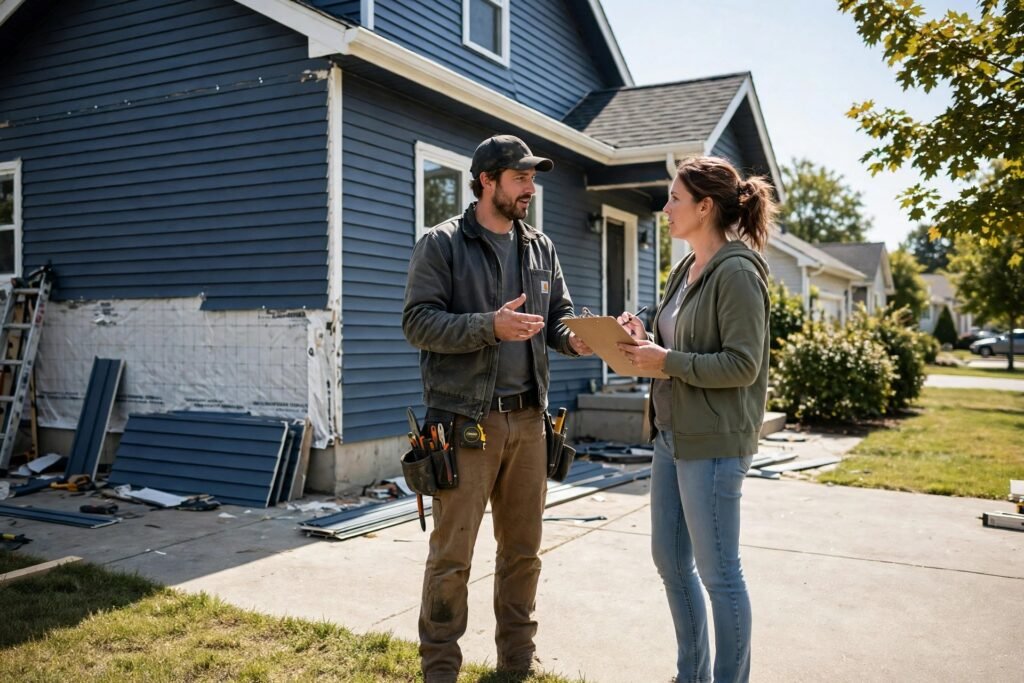
Most siding jobs do not go wrong on installation day. They go wrong three weeks earlier, at the kitchen table, when a homeowner signs a quote that never named the material grade, the moisture barrier, or what happens to the rotted sheathing underneath. By the time those questions surface, the old siding is in a dumpster and your leverage is gone. That is why your siding installation cost is really decided by the questions you ask before anyone picks up a pry bar. This is not a price list with a checklist stapled to it. It is the checklist itself — twelve questions, in the order to ask them, with what a good answer sounds like, what a vague answer is hiding, and the planning price ranges each answer moves.
Print it, work through it with every bidder, and write the answers into the contract. A contractor who answers all twelve clearly is telling you something about the job before the job starts.
First, the numbers these questions are protecting
You cannot judge an answer about cost if you do not know the shape of the market. For a typical single-family home (roughly 1,500–2,000 square feet of wall area), installed siding in 2026 commonly falls in these planning bands:
| Siding material (installed, 2026) | Typical range per sq ft of wall |
|---|---|
| Vinyl | $4 – $9 |
| Fiber cement (e.g. Hardie-type board) | $8 – $14 |
| Engineered wood | $7 – $12 |
| Natural wood / cedar | $9 – $16 |
| Metal (steel or aluminum) | $8 – $15 |
| Brick or stone veneer accent areas | $15 – $30+ |
A full mid-range vinyl re-side often lands around $8,000–$16,000 all-in; fiber cement on the same house commonly runs $14,000–$26,000. Those totals swing with region, stories, how much trim and soffit work is included, and what is found under the old siding. Run your own house size and material through our free Project Cost Calculator before the first meeting, so every answer below is measured against a range you already trust. Costs vary by region, materials, and scope — the questions exist precisely because two quotes $6,000 apart are usually quoting two different jobs.
The first three questions: what exactly am I buying?
1. Which exact product — brand, line, and thickness or grade?
“Siding” is not a product. Vinyl alone runs from thin builder-grade panels (around .040 inch) that oil-can and crack early, to premium panels (.046 inch and up) with better rigidity, wind ratings, and color retention. Fiber cement varies by thickness and finish — factory-painted costs more up front than primed-and-paint-on-site, and the difference shows up in the quote as a mystery gap if nobody names it.
Good answer: the brand, product line, thickness or profile, and color are named in writing, with the manufacturer’s spec sheet available. Vague answer: “premium vinyl” with no line or thickness. That phrase has no enforceable meaning, and it is where a low bid quietly lives.
2. What is included in the square-foot price — and what is a line-item extra?
Ask specifically about: tear-off and disposal of the old siding, house wrap or weather-resistive barrier, insulation board if any, trim, corner posts, J-channel, soffit and fascia, window and door flashing, and painting or caulking where the material needs it. Each excluded item is a future change order.
This is the same discipline as our 12-step contractor hiring checklist applies to any trade: compare bids only when every bidder has priced the identical scope, in writing.
3. How are you measuring my house?
Siding is priced by wall area, and honest measurements can still differ. Does the quote deduct for windows and doors (many installers deduct partially or not at all, which is legitimate if disclosed), include a waste factor (typically 10–15%), and count gable triangles? Ask to see the measurement. A bidder who walks you around the house with the numbers is behaving very differently from one who produced a total from the driveway.
Questions four to six: what happens under the siding?
This is the section homeowners skip, and it is the section that decides whether new siding lasts thirty years or traps moisture for five.
4. What do you do if you find rot or damaged sheathing?
On any house old enough to need re-siding, some damaged sheathing, soft spots around windows, or insect damage is a realistic possibility. The question is not whether it might appear — it is how it gets priced when it does.
Good answer: a stated per-sheet or per-square-foot repair rate, written into the contract before tear-off, plus a promise to show you the damage (photos are fine) before covering it. Vague answer: “we’ll take care of it” or “we’ll figure it out.” Figured-out-later repairs, priced when your walls are already open, are the single most common siding budget blow-up.
5. What goes between the sheathing and the siding?
Ask for the weather-resistive barrier by name (house wrap, felt, or a drainable system), how seams and penetrations are taped or flashed, and how window and door openings are integrated. Fiber cement and engineered wood also have manufacturer clearance and flashing rules — ground clearance, roof-line clearance, butt-joint treatment — that the warranty depends on. If the installer cannot describe their water management in two plain sentences, that is an answer too.
6. Are you addressing why the old siding failed?
Siding that failed early usually had help: a leaking gutter line pouring behind it, missing kick-out flashing where a roof meets a wall, sprinklers soaking one elevation, or paint and caulk failure on a wood product. New siding over an unfixed water source fails the same way, on your new warranty clock. A good bidder names the likely cause unprompted. If yours does not, ask directly — and get any related fix, such as gutter or flashing work, priced as its own line rather than absorbed into a vague total.
Questions seven to nine: who is doing the work, and under what rules?
7. Who actually installs it — your crew or a subcontractor?
Subcontracting is normal in siding and not a disqualifier. What matters is disclosure: who supervises on site daily, who you call with a problem, and whether the warranty in question 10 comes from the company you are paying or a crew you never met. Ask who pulls the permit, too — in most jurisdictions the answer should be the contractor, never you as the homeowner.
8. Does this job need a permit, and what about my HOA or historic district?
Many cities require a permit for re-siding, especially when sheathing or structural elements are replaced; many HOAs require color and material approval before work starts, and historic districts can restrict materials outright. Neither delay is the contractor’s fault — but a contractor who raises both before you sign is saving your schedule. Starting without a required approval can mean stopping mid-job with a wall open.
9. What does the timeline really look like?
A typical full re-side runs about 1–2 weeks of active work for a crew, but the honest answer includes the parts around it: material lead time (special-order colors and fiber cement finishes can add weeks), weather days, the inspection schedule if a permit is involved, and what your house looks like overnight while walls are open. Ask what is protected if rain arrives mid-tear-off. If you are planning this around a season, the same planning logic in our landscaping cost guide applies — exterior trades book out earliest in spring, and the calmest quotes often come from scheduling before the rush, not during it.
Questions ten to twelve: the money and the paper
10. Which warranties do I actually get — and what voids them?
There are always two warranties, and they are not the same document:
- Manufacturer warranty on the material — often long on paper (limited lifetime is common marketing language for vinyl and fiber cement), pro-rated in ways worth reading, and conditional on installation following the manufacturer’s instructions.
- Workmanship warranty from the installer — commonly 1–5 years, covering leaks, loose panels, and installation defects.
Ask for both in writing, ask who registers the manufacturer warranty (you or them), and ask the void question directly: incorrect clearances, unapproved paint on fiber cement, or missing flashing can void material coverage, which is exactly why questions 4 and 5 matter.
11. What is the payment schedule, tied to what?
A reasonable structure ties payments to visible milestones: a modest deposit, a payment when materials are delivered and tear-off is complete, and the final payment only after the walkthrough in question 12. Be wary of a large share demanded up front in cash, pressure to sign today, or a quote with no line items at all — those are among the classic patterns in our guide to contractor scams and red flags, and siding’s big ticket makes it a favorite target.
Before the first payment, sanity-check the total one more time in the Project Cost Calculator. Questioning a number is easy at the kitchen table and very hard from a scaffold.
12. What does the final walkthrough check — and who fixes the punch list?
Agree the ending before the beginning. A real walkthrough checks, elevation by elevation: seams and butt joints, caulk lines, trim fit, corner alignment, fasteners showing where they should not, clearance at grade and rooflines, and cleanup — including a magnet sweep for nails if tear-off dropped them in the yard and driveway. Ask how punch-list items are scheduled and whether the final payment is explicitly held until they are done. Put the answer in the contract.
How the answers move your siding installation cost
Notice what happened across those twelve questions: almost none of them were “can you do it cheaper?” Yet they explain nearly every legitimate price difference you will see:
- Material grade (Q1) can move a vinyl quote by 30–50% on its own.
- Scope completeness (Q2) is the difference between a quote and a quote plus four change orders.
- Rot and sheathing rates (Q4) decide whether a surprise costs hundreds or thousands.
- Barrier and flashing work (Q5–Q6) is invisible in photos and decisive in lifespan.
- Warranty terms (Q10) tell you what the low bid actually stands behind.
If one bid is far below the others, do not ask that bidder to justify the discount. Ask the twelve questions again and find which answer changed. The missing line is the discount. Homeowners comparing exterior work on a house painting budget sometimes discover the same thing from the other direction — prep and repair scope, not the finish coat, is where exterior quotes truly differ.
Frequently asked questions
How much does siding installation cost for an average house in 2026? For roughly 1,500–2,000 square feet of wall area, plan on about $8,000–$16,000 installed for mid-range vinyl and $14,000–$26,000 for fiber cement, with engineered wood and cedar in and above that band. Region, stories, trim scope, and hidden repairs move the total — which is why the per-question scope checks in this guide matter more than any single average.
Can new siding go over old siding? Sometimes over wood, if the existing layer is flat, sound, and local code allows it — and it can save tear-off cost. It also adds thickness that can bury window and door trim, can trap existing moisture problems out of sight, and is not approved for every material. Ask the bidder to state in writing whether they are quoting over or off, and why.
How long does siding last? Vinyl commonly lasts 20–30+ years, fiber cement 30–50 years, engineered wood 20–30 years with maintained paint, and cedar varies widely with maintenance. Installation quality — flashing, clearances, water management — moves those numbers more than brand choice does.
Is fiber cement worth the extra cost over vinyl? It buys rigidity, a more wood-like appearance, strong fire resistance, and long service life; it costs more to buy and install, weighs more, and needs paint maintained over time. In high-wind, high-sun, or strict-HOA settings the case strengthens. Run both materials on your own measurements before deciding — the gap on your house may be smaller or larger than the national band suggests.
Should I replace siding and windows at the same time? If both are genuinely due, doing windows first (or together) lets flashing integrate properly and avoids disturbing new siding later. If the windows have years left, siding alone is fine — but tell the siding bidder, because trim and flashing details around existing windows are part of the scope questions above.
Prices are national averages for planning purposes; your local quotes will vary by region, materials, and scope. Always get at least three written bids on the same scope before you hire.
About this guide
This guide was researched and written by the Find Contractor editorial team for US homeowners. Cost figures are national planning ranges built by comparing multiple published 2025–2026 cost sources — they are not a quote. See How We Research Costs for our full method, and always get at least three written, itemized bids before you hire.