
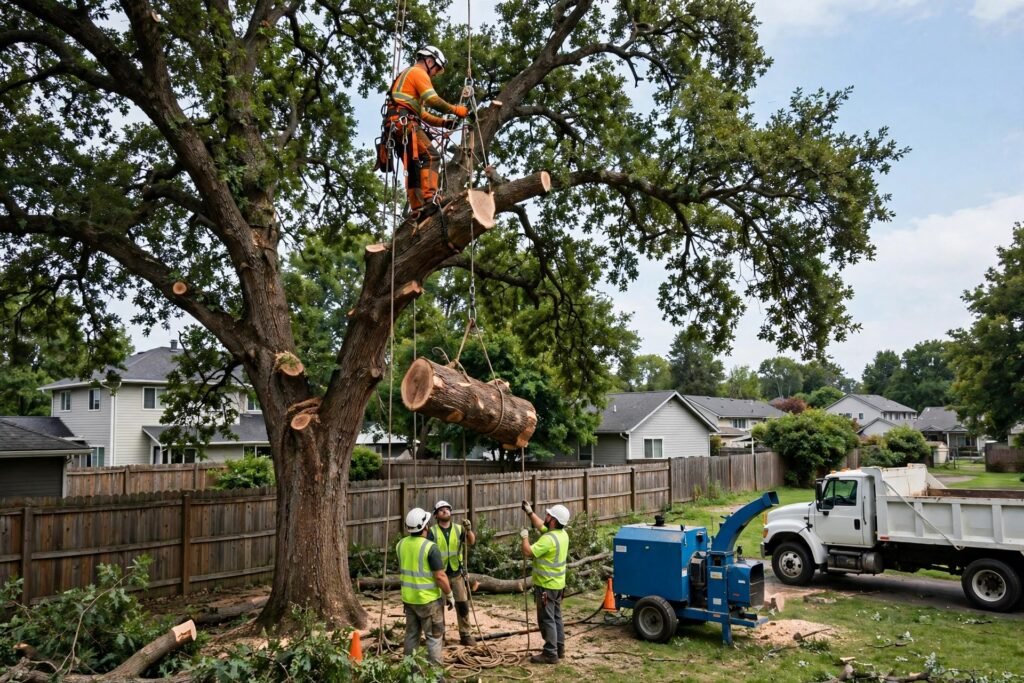
Tree Removal Cost in 2026: Pricing by Tree Size, Access, and Stump Work
Start by measuring, not by calling. Walk out to the tree you are worried about, wrap a tape around the trunk at chest height, and look up: is the canopy over open lawn, or is it hanging over a roof, a fence, and a power drop at the same time? That one look explains more about your tree removal cost than any national average can. Tree work is priced on size and risk, not on a flat per-tree fee — a 25-foot maple in an open backyard and a 70-foot oak leaning over a house are both “one tree,” and they can be $2,000 apart. This guide prices the job the way a tree service does: by height and trunk size first, then by access, condition, and what happens to the stump.
Late fall is when a lot of homeowners finally make this call, and for good reason. Leaves are down, so a climber and an arborist can actually see the structure — dead limbs, cracks, included bark, and rot pockets that summer foliage hides. If a tree looked questionable in August, November is the honest month to have it assessed. You do not need to decide removal on the first visit. You need three comparable, written scopes for the same tree.
Measure first: the two numbers every bidder will use
You do not need arborist tools to give bidders a useful starting point, and having these numbers before you call prevents vague phone quotes that double on site.
Height, in bands. You will not measure it exactly, and you do not need to. Tree services quote in height bands because height decides the crew, the rigging, and whether a bucket truck or crane is involved:
- Small — under 30 feet: many ornamentals, young maples, dogwoods, redbuds, small pines. Often a one- or two-person job with no crane.
- Medium — 30 to 60 feet: mature shade trees in most suburbs. This is the most common removal band.
- Large — over 60 feet: mature oaks, cottonwoods, large pines, and older silver maples. Expect a larger crew, sectional rigging, and a higher base price before access is even considered.
Trunk diameter at breast height (DBH). Measure the circumference at about 4.5 feet off the ground and divide by 3.14. A trunk around 12 inches across behaves very differently on a saw and a chipper than one at 30 inches. Bidders use diameter to estimate wood volume, cutting time, and disposal weight.
Write both numbers down, note what is underneath the canopy (roof, deck, fence, garden, lines), and note how a truck or chipper would reach the tree — wide side gate, narrow gate, slope, or only through a neighbor’s yard. That short note is your scope. Every bid you collect should price that tree, in that position, to the same finish: stump ground or left, wood hauled or left, brush chipped or stacked. Without that, you are not comparing prices. You are comparing different jobs, which is exactly the discipline our 12-step contractor hiring checklist applies to any trade.
Tree removal cost by size: the 2026 ranges
Here are the planning ranges for a full professional removal — felling or sectional takedown, brush chipped, trunk wood hauled away, basic site cleanup — with the stump handled separately (see the stump section below; many quotes split it out). All figures are national planning ranges for 2026; costs vary by region, materials, and scope, and access and condition move any tree within — or beyond — its band.
| Tree size (height) | Typical trunk diameter | Typical planning range, removal only |
|---|---|---|
| Small, under 30 ft | Under 12 in. | $400 – $900 |
| Medium, 30–60 ft | 12–24 in. | $900 – $1,800 |
| Large, 60–80 ft | 24–36 in. | $1,600 – $3,200 |
| Extra-large or high-risk, 80 ft+ or over a structure | 36 in.+ | $2,800 – $5,500+ |
| Emergency / storm removal (same tree, urgent, damaged or fallen on a structure) | Varies | Often 1.5×–2× the planned-removal price |
Read the table with two cautions. First, “removal only” in most markets means the tree comes down and the debris leaves. Stump grinding, root work, and replanting are separate lines — a quote that looks $400 cheaper is often just a quote without the stump. Second, the high end is not padding. A large tree over a roof that has to come down in small rigged sections, with a crane day and a four-person crew, legitimately costs several times an open-lawn felling of the same species. If your tree is in the large band, run a first sanity check in our free Project Cost Calculator before quotes arrive, so you can hear a $3,000 bid as a size-and-access price rather than as a shock.
A few reference points help the scale feel real. Removing two medium trees in the same visit usually costs less than twice one tree — the crew, chipper, and trucks are already there — so bundling genuinely planned removals is one of the few real savings in this trade. Conversely, a single small tree with terrible access (steep slope, no machine access, everything carried out by hand) can price like a medium tree in an open yard. Size sets the starting point. Access sets the finish.
What a complete removal quote should actually list
A good tree quote reads like a work order, not a single number on a business card. Look for these lines, named separately:
- Takedown method — felled whole (only where there is a clear drop zone), sectional/climbing takedown with rigging, bucket truck, or crane-assisted. The method is the price driver; it should be written down.
- Brush and wood — chipped on site or hauled, trunk rounds left for firewood or removed, and who keeps the mulch if the brush is chipped.
- Stump — ground (and to what depth), removed entirely, or left cut low. Priced separately in most quotes.
- Cleanup — raking, blowing hard surfaces, and hauling. “Cleanup included” should still say what it covers.
- Protection — plywood or mats over lawn/driveway where machines cross, and how nearby plantings, fences, and irrigation are protected.
- Permits and notifications — who pulls any required permit and who contacts the utility if lines are involved (more on both below).
If a quote is missing the stump line and the haul line, it is not yet comparable to one that includes them. That same habit — measure the thing, name the pieces, price the lines separately — is what makes the per-foot logic in our gutter installation cost guide and the per-square-foot logic in our concrete driveway cost guide useful, and it works identically here.
The five factors that swing the price most
1. Access for people and machines
Open access — a wide gate, flat ground, room for a chipper and a truck — is the cheapest version of every removal. Tight access adds labor on every step: brush dragged by hand, wood carried in rounds, no bucket truck, sometimes no chipper at the tree at all. Slopes, soft ground after rain, and long carries all add time, and time is what you are buying.
2. What the tree is hanging over
A tree over open lawn can often be felled or dropped in large sections. A tree over a roof, pool, deck, glass, or a neighbor’s fence comes down in small, roped pieces, each one lowered rather than dropped. That rigging work is slower, more skilled, and the main reason two same-size trees get very different bids. Trees touching or near service drops and power lines are a special case — see the permit and utility section below. Do not let a general crew improvise around energized lines.
3. Lean, damage, and dead wood
A healthy tree holds rigging predictably. A dead, hollow, cracked, or storm-split tree does not — pieces can fail in unexpected directions, climbing may be unsafe, and the crew may need a bucket or crane precisely because the tree cannot be trusted to hold a climber. Ironically, the trees homeowners most want gone — visibly dying, leaning after a storm — are often the most expensive to remove safely. Getting a declining tree assessed before it becomes a dead tree is one of the few ways to pay the lower version of this bill.
4. Species and wood density
Hard, dense woods (oak, hickory, locust) cut slower and weigh more to haul than soft woods (pine, poplar, willow) of the same dimensions. Multi-trunk trees, tight crotches with included bark, and trees wrapped in vines or with metal embedded in the trunk (old clothesline hardware and fence wire are common finds) all add cutting and disposal time.
5. Crane days and emergency timing
A crane is not an upsell when it is named for a reason: no drop zone, no safe climbing structure, or a tree already resting on a building. Crane-assisted removals add the crane and operator as a distinct cost block — commonly several hundred to well over a thousand dollars for the crane portion alone — and should be quoted as such, not folded silently into a single number. Emergency work after a storm carries a premium for the same reason any urgent trade call does: crews are triaging, days run long, and the work is the most hazardous version of the job. If a fallen tree is stable, not on a structure, and not blocking access or a utility, ask whether scheduling it as planned work in the following days prices it lower. Often it does.
The stump is a separate decision (and a separate price)
New homeowners are routinely surprised that “tree removal” leaves a stump. Grinding is the standard finish: a grinder chews the stump and the surface roots down below grade — commonly 6 to 12 inches — leaving a mulch-filled depression you can top with soil and seed or sod.
| Stump work (2026) | Typical planning range |
|---|---|
| Stump grinding, small stump (under 12 in.) | $100 – $250 |
| Stump grinding, medium stump (12–24 in.) | $200 – $450 |
| Stump grinding, large stump (24 in.+) | $350 – $750+ |
| Full stump and root-ball removal (excavation, usually for construction or replanting in the exact spot) | $500 – $1,500+ |
| Grinding each additional stump on the same visit | Often discounted — the machine is already on site |
Three questions settle the stump before work starts. How deep? Shallow grinding is fine under lawn; if you plan to replant a tree in the same hole or build over the spot, say so — the scope changes. Who hauls the grindings? A large stump produces a surprising mound of mulch; leaving it, spreading it, and hauling it are three different prices. What is underneath? Irrigation lines, shallow utilities, and old concrete footings near the stump should be flagged before grinding, not discovered by the grinder.
If the stump sits in a back corner and you are in no hurry, leaving it cut low and letting it decay is a legitimate $0 option — just price the grinding version too, so the choice is informed. Yard budgets often cover the stump and the cleanup around it in the same season as other exterior work; our landscaping cost guide shows how that follow-on work (soil, seed, replanting) is typically priced once the tree itself is gone.
Removal is not always the answer: trimming, cabling, and watching
A tree service that only sells removals will find removal necessary everywhere. Before you approve a takedown for a tree that is not clearly dead, hazardous, or badly placed, ask what the alternatives cost:
- Pruning / trimming — removing deadwood, lifting the canopy, thinning for wind, or clearing a roofline commonly runs $300–$1,200 depending on size and access, and can add years of safe life to a sound tree. It is also the right spend when the real complaint is shade, gutters full of debris, or limbs over a roof rather than the tree itself. (If those gutters are already failing, price that fix separately with our gutter guide rather than bundling it into a tree bid.)
- Cabling and bracing — hardware that supports a weak union in an otherwise valuable tree, commonly $400–$1,000 installed, with periodic inspection. It manages risk; it does not eliminate it, and an honest arborist will say which trees are poor candidates.
- Assessment only — a written health and risk assessment from a qualified arborist, sometimes a modest fee and sometimes credited toward work. For a large tree you would rather keep, this is money well spent before any saw is discussed.
A useful test: if the person quoting removal will not discuss pruning or assessment as alternatives — with prices — you are talking to a removal crew, not getting tree advice. Get at least one bid from a company that does both. The same comparison habit applies indoors and out: the age-plus-repair-price logic in our water heater replacement cost guide is the same decision in a different trade — fix, support, or replace should each carry a number before you choose.
Permits, protected trees, and power lines
Tree rules are local, and assuming “my yard, my tree” can be an expensive mistake in some cities.
- Permits and protected species. Many cities require a permit to remove trees above a certain trunk diameter, heritage or protected species, or trees in a front yard, easement, or conservation area — and some HOAs have their own approval on top of the city’s. Fines for unpermitted removal can exceed the removal price itself, and replacement planting is sometimes required. Ask each bidder directly: “Does this tree need a permit here, and who obtains it?” A local crew should answer without hesitation. If your project also involves a new boundary or clearing for one, the permit-and-timeline thinking in our fence installation cost guide will feel familiar — paper first, digging second.
- Call before anyone climbs near lines. Distinguish the utility’s lines (pole to pole, and often the service drop) from your lines. Utilities typically handle clearance and removal work in their lines, sometimes at no direct charge for the line-clearance portion, but they do not do cosmetic or full private removals. Never hire a crew to “just work around” a line the utility should handle. Call the utility first and let them define the boundary in writing.
- Call 811 before stump grinding or excavation where lines might be shallow, just as you would before digging post holes. Grinders and excavators find buried lines efficiently and expensively.
- Insurance and credentials. Tree work is among the most hazardous home services. Ask for a certificate of insurance naming general liability and workers’ compensation, sent from the insurer or agent if you want certainty, and verify any license or registration your state or city requires for tree services. A low bid from an uninsured crew leaves the homeowner holding the risk for injuries and property damage on their own lot. That risk pattern — cheap bid, missing paperwork, pressure to start — is catalogued in our guide to contractor scams and red flags, and tree work after storms is one of its classic settings: out-of-area crews, cash demands, and no verifiable address.
Can you do any of this yourself?
Honestly and narrowly, yes — at the small end, with firm limits.
Reasonable for a capable homeowner: felling a small, healthy tree (under about 15–20 feet) in a wide-open area with a clear fall path away from structures, people, and lines, if you are experienced with a chainsaw and wear proper protective equipment. Also reasonable: cutting up a tree that is already safely on the ground, hauling brush, and the small follow-on fixes — patching lawn, spreading grindings — that sit in handyman territory. Our handyman cost guide and the handyman cost per hour breakdown show what it costs to hand those pieces off instead if you would rather not.
Hire a pro, without exception, when: the tree is medium or large, leans toward anything valuable, is dead or damaged, is near any line, needs climbing or rigging, or stands where a misjudged fall hits a roof, fence, or neighbor’s property. Chainsaw kickback, widow-maker limbs (broken branches hung up in the canopy), and trunks that roll or spring under tension injure experienced people. The savings on a medium removal do not survive one emergency-room visit or one roof repair — and roof work after a DIY fall gone wrong prices out in our roof and window replacement cost guides at multiples of the removal you were trying to save on.
Renting a stump grinder is the one middle case: for a few small, accessible stumps, a rental plus a day of careful work can beat the grinding quote. Price both honestly — rental, transport, fuel, and your day — against the per-stump numbers above, especially the discounted additional-stump rate when a crew is already coming for the tree.
How to compare three bids without guessing
Collect the bids against your written scope from the measurement section — same tree, same stump finish, same haul decision — then line them up in this order:
- Method and crew. Is the takedown method named, and does it fit the tree’s position? A suspiciously low bid for an over-the-roof tree often assumes felling where felling is impossible.
- Stump and debris. Grinding included or extra? Depth? Wood hauled or left? Cleanup defined?
- Paper. Insurance certificates, permit responsibility, and utility coordination — present or promised vaguely?
- Price, in context. Compare the total for the same finish against the size table above and a second pass through the Project Cost Calculator. A bid modestly above the band with a crane and rigging named is more credible than a bid below the band with no method stated.
- Payment terms. Reputable tree services typically bill on completion for residential removals, or take a modest deposit on large multi-day work — paid to the business, by a traceable method, against a written scope. Large cash deposits demanded before any equipment arrives belong in the red-flag file, not in your budget.
One scheduling note that saves real money: if the tree is stable and the work is not urgent, ask about off-peak scheduling. After storm surges pass and in the quieter winter weeks (when structure is visible anyway), some crews price planned work more flexibly than during peak spring and storm season. Ask the question; do not assume the first date offered is the only price available.
Frequently asked questions
How much does tree removal cost for an average suburban tree in 2026? Most medium shade trees — 30 to 60 feet, reasonable access, debris hauled — land around $900–$1,800 for the removal, plus $200–$450 if you add stump grinding. Small open-yard trees run lower ($400–$900); large or over-a-structure trees run $1,600–$3,200 and beyond. Your access and what the tree hangs over decide where in the band you fall.
Does homeowners insurance pay for tree removal? Generally, insurance responds when a covered event (like a storm) causes a tree to fall and damage a covered structure — and even then, the removal portion is often capped or limited to the part affecting the structure. A standing, declining tree you remove preventively is almost always a homeowner maintenance cost. Read your own policy’s tree language and document storm damage with photos before cleanup if you believe a claim applies; do not rely on a tree crew’s guess about your coverage.
Should I keep the wood to save money? Keeping trunk rounds for firewood can trim the hauling portion modestly — ask for the with-hauling and without-hauling prices as separate lines so the saving is visible. Remember that you then own the splitting, stacking, and seasoning, and that wood from a diseased tree should not be moved to other properties where it can spread the problem. Brush chipping is rarely worth declining; the volume surprises everyone.
How long does a removal take? A small open-yard tree is often under two hours. A medium sectional removal commonly takes half a day to a full day; large, rigged, or crane-assisted removals can take a full day or more, plus a separate shorter visit for stump grinding if it is scheduled apart. Weather, ground softness, and utility coordination are the usual schedule risks — ask what would move your date.
When is the cheapest time to remove a tree? Planned work in the off-peak season — often late fall and winter in many regions — tends to price and schedule better than spring rushes and post-storm periods, and leafless structure makes assessment more accurate. Emergency and storm work is always the most expensive version. If the tree is safe to wait on, waiting for a planned slot is the saving. If it is not safe, that premium is the price of the risk, not a rip-off.
Prices are national averages for planning purposes; your local quotes will vary by region, materials, and scope. Always get at least three written bids on the same scope before you hire.
About this guide
This guide was researched and written by the Find Contractor editorial team for US homeowners. Cost figures are national planning ranges built by comparing multiple published 2025–2026 cost sources — they are not a quote. See How We Research Costs for our full method, and always get at least three written, itemized bids before you hire.