
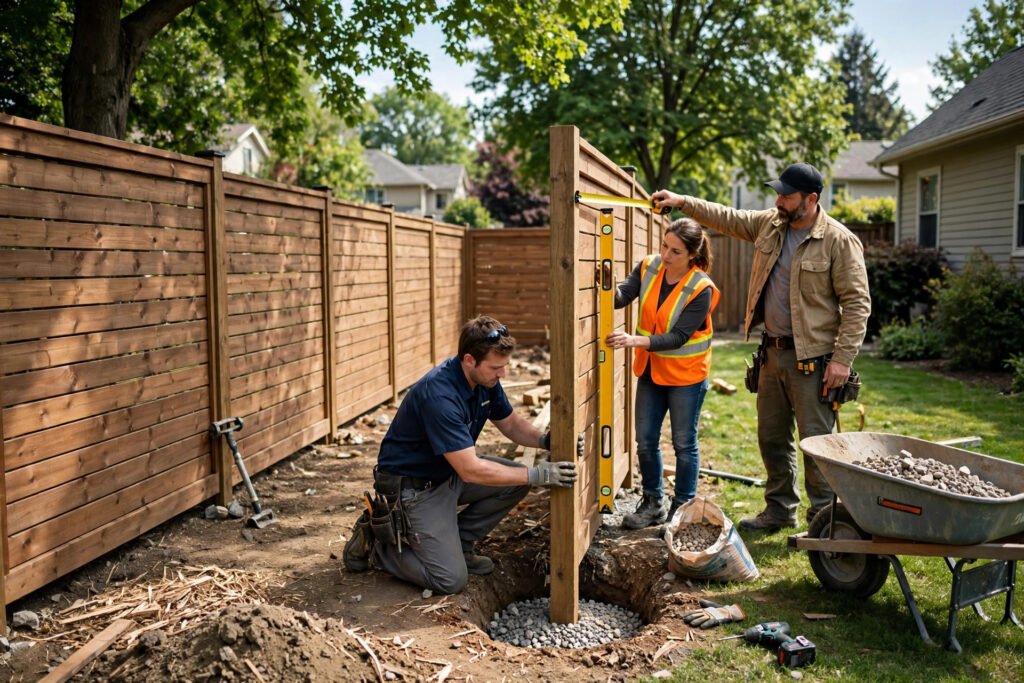
Fence Installation Cost and Permits: How Long It Really Takes (and What Delays It)
Here is the part nobody tells you at the home center: the fence itself takes about two days to build. The fence project takes three to six weeks. Your fence installation cost is quoted by the linear foot, but your schedule is decided by everything around those two days — a survey you may not have, a permit office with its own calendar, an HOA committee that meets twice a month, and a utility-marking ticket that has to age before anyone can dig. Homeowners who understand that gap plan a calm project. Homeowners who do not spend week three asking why no one has started digging yet. This guide lays out the full timeline in order, what each phase costs, and the specific delays that stretch a simple fence into a season — so you can see the whole calendar before you sign anything.
The real timeline, week by week
Every fence job moves through the same phases, whether the contractor mentions them or not. The install days are the shortest line on this table.
| Phase | Typical time | What is actually happening |
|---|---|---|
| Quotes and measuring | 2–7 days | Two or three bidders measure the run, confirm gates, and price the same scope |
| Survey / property-line confirmation | 0–14 days | You find an existing survey, or a surveyor marks the corners (see below) |
| HOA approval (if applicable) | 1–4 weeks | Application, drawings, and a committee that may only meet monthly |
| Permit (where required) | 2 days – 3 weeks | Application, plan review, and issuance — timing varies widely by city |
| Utility marking (811) | At least 2–3 business days | Locators mark buried lines; digging before tickets clear is illegal in most states |
| Material delivery | 2–10 days | Stock panels are fast; specialty vinyl, aluminum, and gates can be special-order |
| Old fence removal | Half a day – 1 day | Tear-out, post extraction, and haul-away |
| Installation | 1–3 days | Day one is usually posts and concrete; panels, pickets, and gates follow |
| Final walkthrough / inspection | 1–7 days | Punch list, gate alignment, and a final inspection where the permit requires one |
Add it honestly and a straightforward backyard privacy fence is a 3–5 week project with 2 days of visible construction. That is not contractor slowness. Most of those weeks are waiting on paper, and paper can be started early — which is the entire strategy in the last sections of this guide.
Do you need a permit for a fence?
Sometimes — and the honest answer depends on your city, your lot, and where on the lot the fence sits. Common patterns across US jurisdictions:
- Backyard fences at or under 6 feet are exempt from a building permit in many cities, though zoning rules on height and placement still apply even when no permit is issued.
- Front-yard fences are regulated almost everywhere, usually with lower height limits (often 3–4 feet) and sometimes a separate approval.
- Corner lots get extra scrutiny, because a tall fence can block sight lines at intersections. Expect setback and visibility-triangle rules.
- Fences over 6–7 feet, masonry or concrete fences, retaining-wall fences, and pool barriers need a permit in most places that have weighed in at all — pool fencing is also governed by safety codes with self-closing, self-latching gate requirements.
- Easements are a hard boundary. A fence over a utility or drainage easement can be ordered removed at your expense, permit or no permit.
If you have replaced a water heater, you have already met this permit office and its logic: the fee is modest, the review is mostly about safety and placement, and the expensive version of the story is always the one where the work happened first and the questions came later. A fence pulled down and rebuilt six inches inside the line costs far more than the permit ever would. Ask the question before the posts go in — your contractor should know the local answer cold, and “we never pull permits for fences” without a height or location qualifier is not that answer.
One more paper item that is not a permit: many cities and some states require the fence to sit either exactly on the property line (with neighbor agreement, in writing) or a set distance inside it. Which side faces out also gets regulated — the “finished” side toward the neighbor or street is the rule in a lot of towns, and it affects cost when it forces a style change.
The survey is the step nobody budgets for
More fence timelines die on property lines than on any other single issue. If you have a recent survey from your home purchase, this phase takes an afternoon of digging through closing documents. If you do not, a new boundary survey for a typical suburban lot commonly runs $300–$600, and surveyors book out one to two weeks in busy seasons — that wait belongs on the calendar above, not in a panic later.
Why it matters this much: a fence built over the line is not a small mistake. The remedies are moving the fence (a second installation bill), buying an easement, or litigating with a neighbor you still live next to. All three cost more than the survey. A contractor who asks to see your survey — or prices the job “subject to line confirmation” — is protecting both of you. A contractor who happily builds wherever you point, on a line nobody has verified, is handing you the risk.
While the lines are being confirmed, make the free call: 811, at least 2–3 business days before any digging. Locators mark buried electric, gas, water, and communications lines, and the ticket has a start date and an expiry. Post holes go 2–3 feet down — exactly where those lines live. Hitting one converts a two-day install into an emergency repair, a fine in some jurisdictions, and a timeline nobody can quote you.
HOA approval: the silent delay
If your neighborhood has an HOA, its architectural review is usually the longest single wait on the project — and the one most often discovered last. Typical requirements include the fence style, height, material, and color, a site plan showing placement, and sometimes a neighbor notification. Committees that meet monthly turn a missed submission date into a four-week delay by themselves.
Two cost consequences hide here. First, an HOA that restricts materials — wood-look only, no chain link, a specific vinyl color — can move you into a more expensive product line after you have already collected quotes on another one. Second, starting without approval risks a removal order, which is the single most expensive outcome in fencing. Get the approval letter before materials are ordered, and get your bidders quoting the approved spec, not the one you hope gets approved.
Fence installation cost, phase by phase
Now the money, in the same order as the calendar. Fences are priced by the linear foot, installed, and the material is most of the spread:
| Fence material (installed, 2026) | Typical range per linear foot |
|---|---|
| Chain link | $12 – $30 |
| Pressure-treated wood privacy | $20 – $45 |
| Cedar privacy | $30 – $55 |
| Vinyl (PVC) privacy | $35 – $65 |
| Aluminum (ornamental / pool) | $45 – $80 |
| Composite | $50 – $90 |
| Wrought iron / steel | $60 – $110+ |
For a typical suburban backyard run of 100–150 linear feet with one or two gates, that works out to roughly $2,500–$6,500 for wood privacy and $4,000–$9,000 for vinyl privacy, with chain link well below both and ornamental metal well above. Gates are the line item to read twice: a standard walk gate is often included in the per-foot rate or priced at a few hundred dollars, while a wide double drive gate — especially with posts set in concrete footings solid enough to carry it — can add $800–$2,500 on its own.
The phases around the fence itself carry their own smaller costs: survey ($300–$600 if you need one), permit fees (commonly $50–$400 where required), old-fence removal and disposal (often $8–$20 per linear foot when it is not folded into the quote), and stump or brush clearing along the line. Run your own footage and material through our free Project Cost Calculator before the quotes come back, so you can see whether a bid’s total is built from the fence or padded around it. Costs vary by region, materials, and scope — a sloped lot, rocky soil, or a run broken up by trees and corners pushes any material toward the top of its band.
The delay catalogue: seven things that actually push a fence job
- Weather and concrete. Posts set one day need the concrete to cure before panels hang — and rain on post day moves the whole sequence, not just that day.
- A survey that has to be ordered. One to two weeks, discovered at the worst moment if nobody asked early (see above).
- An HOA cycle. Miss the monthly meeting and the project waits a month. Nothing the contractor does can compress this.
- Permit review backlogs. Spring applications stack up in busy permit offices; the same application filed in late winter often clears in days.
- Special-order materials. Stock wood panels move fast. Specific vinyl colors, aluminum styles, and custom gates can carry 1–3 week lead times after approval.
- A line dispute with a neighbor. Even a friendly disagreement pauses work until the survey settles it. A heads-up conversation before you build — ideally with the survey in hand — prevents most of these.
- Spring backlog. Fence crews book out furthest exactly when everyone calls. The identical job quoted in February often starts sooner and prices calmer than the one quoted in May — the same seasonal logic that governs landscaping scheduling applies to every exterior trade.
Notice the pattern: not one of these seven is “the crew worked slowly.” Fence timelines are won or lost in the paperwork phase, weeks before the first post hole.
How to compress the timeline without cutting corners
You cannot shorten a committee cycle or a permit review — but you can stop running the phases in a queue when most of them can overlap:
- Start the survey, HOA application, and quotes in the same week. None of them depends on the others, and together they are the entire front half of the calendar.
- Order materials the day approval lands, not the day the crew is free. Lead time and backlog then run in parallel instead of in series.
- Book the 811 ticket against the install date as soon as the crew gives you one, and re-mark if the ticket expires before digging starts.
- Sequence the yard once, not three times. If this is a bigger exterior season, plan the order deliberately: fences before planting beds along the line (the landscaping cost guide covers how that work prices out), drainage and gutter discharge sorted before posts go near a downspout line, and any window or exterior work that needs yard access done before the fence closes it in. Re-opening a finished fence line for another trade’s access is a cost nobody quotes you in advance.
- Put the start date and the phase order in the contract. “Weather permitting, posts the week of…” in writing beats a verbal “soon” every time, and it is one of the core habits in our 12-step contractor hiring checklist.
What not to compress: the survey, the permit where one is required, and the utility marks. Skipping any of the three is how a fence becomes the subject of our guide to contractor scams and red flags — the pressure version of this project (“we can start tomorrow, no paperwork needed”) is a pattern, not a favor.
Repairs and small jobs follow different rules
Not every fence problem is a replacement project, and small work runs on a different clock and a different price. A leaning section reset, a gate that will not latch, a few rotted pickets or a storm-damaged panel are often one-visit jobs — the kind of work priced by the hour rather than the foot. Our handyman cost guide covers what that scope looks like, and the handyman cost per hour breakdown shows how the billing actually works, including minimum charges that make a single tiny fix cost more per hour than a half-day bundle. The dividing line is structural: if posts are rotted at grade across multiple sections, or more than about a third of the run is failing, you are pricing a replacement with extra steps — get fence-company quotes on the full run instead of paying hourly to rebuild it one panel at a time.
Before the crew leaves on any job, new or repair, walk the line and check: gates swing and latch without lifting, post tops are level and capped where the style calls for it, the finished side faces the way your town and HOA require, and the gap at grade is consistent — enough to keep the material out of standing water, not so much that it invites digging underneath. Then sanity-check the final invoice against the quote and, if the total drifted, against the Project Cost Calculator one last time while the conversation is still easy.
Frequently asked questions
How long does it take to install a fence once work starts?
Usually 1–3 days for a typical backyard: posts and concrete on day one, panels or pickets and gates after the concrete sets. The full project — survey, approvals, permit, materials, and scheduling — is more realistically 3–6 weeks from first quote to final walkthrough.
How much does fence installation cost for an average backyard in 2026?
For 100–150 linear feet, plan on roughly $2,500–$6,500 installed for wood privacy fencing and $4,000–$9,000 for vinyl privacy, with chain link below that range and aluminum or composite above it. Gates, slope, removal of an old fence, and region move the total inside — or outside — those bands.
Can a fence be built exactly on the property line?
Often yes, but the rules vary: some places require a small setback inside your line, some allow on-the-line fences with written neighbor agreement, and easements override everything. This is exactly what the survey and the permit or zoning check are for — confirm before posts are set, because moving a finished fence is a second installation bill.
Who is responsible for finding the property line — me or the contractor?
Ultimately you, as the owner: a contractor can build to a marked line, but only a survey establishes where the line legally is. Good contractors insist on seeing a survey or marked corners before they dig. Treat a bidder who is happy to guess as a warning sign.
What is the best month to schedule a fence installation?
Late winter into very early spring, where your climate allows it: permit offices and HOA queues are shorter, crews are not yet booked out, and your fence is finished before the season you bought it for. In cold climates, frozen ground can delay post digging — one more reason the paperwork phases should be finished before the thaw.
Prices are national averages for planning purposes; your local quotes will vary by region, materials, and scope. Always get at least three written bids on the same scope before you hire.
About this guide
This guide was researched and written by the Find Contractor editorial team for US homeowners. Cost figures are national planning ranges built by comparing multiple published 2025–2026 cost sources — they are not a quote. See How We Research Costs for our full method, and always get at least three written, itemized bids before you hire.