
Garage Door Replacement Cost Scams: 9 Red Flags That Inflate the Bill
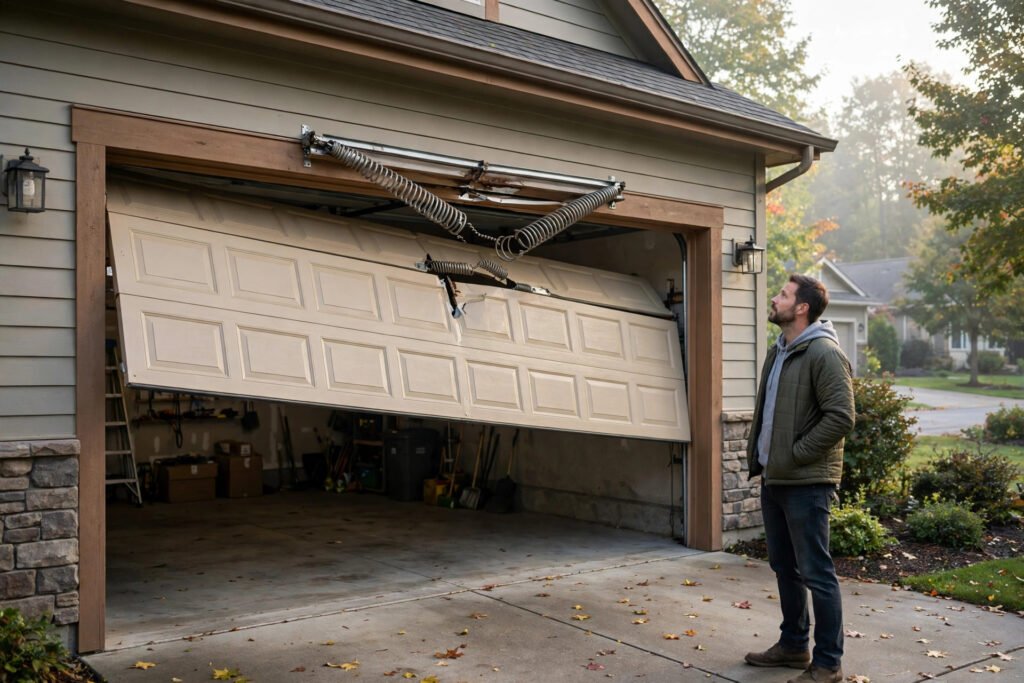
It usually starts before 8 in the morning. The car is packed, you hit the opener, and the door groans, lifts six inches on one side, and stops at an angle. A spring has snapped — you can see the gap in the coil above the door. You search for help on your phone, tap the first listing that promises same-day service, and two hours later a technician in an unmarked truck is telling you the whole system is unsafe, the door itself has to go, and today’s garage door replacement cost will be “around $2,800, but we can start right now if you pay half up front.”
That moment — rushed, half-informed, with a car trapped inside — is exactly where garage door scams make their money. A broken spring is a real repair, commonly a few hundred dollars. A full replacement is sometimes genuinely needed. The scam is not the door. The scam is the pressure, the invented damage, and a bill that doubles between the driveway conversation and the invoice. This is a consumer-protection guide, not a plain price list: learn the nine red flags first, then use the honest cost ranges further down to judge any quote you are handed.
Repair or replace? Answer this before anyone sells you a door
Most morning breakdowns are repair problems, not replacement problems. Sorting that out first is the single best protection you have, because every red flag below depends on blurring that line.
Usually a repair (keep the door):
- One or both torsion springs broken, door otherwise solid and reasonably modern
- A frayed or snapped lift cable, a bent track section, worn rollers, or a failed opener motor
- One damaged panel on a door whose manufacturer still sells matching sections
- The door is under roughly 15 years old, closes evenly, and has no widespread rust, rot, or cracking
Replacement starts to make sense when:
- Multiple panels are damaged, rusted through, cracked, or warped — especially on a door whose panels are discontinued
- The door is 20+ years old, uninsulated, and you are already facing a major repair plus an opener replacement in the same season
- The frame or surrounding structure has shifted, or repeated repairs keep failing for different reasons
- You are changing the opening size, converting the garage, or the door no longer meets current safety expectations (working photo-eye sensors and auto-reverse are the baseline — a door without them needs attention regardless of age)
A useful rule borrowed from other trades: if a repair costs less than about a third of a like-for-like replacement and buys you several more years from a sound door, repair usually wins. If you have lived through a similar decision with a water system, the logic in our water heater replacement cost repair-vs-replace guide is the same — age plus repair price, not a technician’s urgency, should drive the call. And if the job really is just springs, cables, rollers, or a panel swap, that is often a focused pro repair or, for the smallest fixes bundled together, work priced like the jobs in our handyman cost guide — not a four-figure door package.
The 9 red flags
1. The company name keeps changing — or you cannot find it at all
Legitimate garage door companies trade on a stable local name, a physical address, and reviews attached to that exact name over years. A classic scam pattern is the opposite: one call center answers under several different business names, the truck arrives unmarked or with a generic “Garage Door Service” magnet, and the invoice shows yet another name. Search the exact name on the invoice before you pay, not the name in the ad. No verifiable address, no license or registration where your state or city requires one, and no history under that name are reasons to stop — the same first checks our 12-step contractor hiring checklist applies to any trade, and the pattern-matching in our guide to contractor scams and red flags covers this shape of operation in detail.
2. A $29 or $49 “service call” that becomes a hostage negotiation
A very low advertised call-out fee is not automatically dishonest — but in this trade it is a well-worn door-opener for a hard upsell. The technician arrives, takes something apart, and only then reveals the “real” price, with your door now disassembled or disabled and a fee demanded even if you decline. Protect yourself before anything is touched: ask on the phone what the service fee covers, whether it is waived with repair, what happens to the fee if you say no, and whether you will get the diagnosis and price in writing before work begins. A company that will not answer those four questions clearly has answered the fifth one for you.
3. “Your springs are the wrong size — and so are your cables, drums, and bearings”
Springs are the most abused line item in garage door repair. A broken spring is visible and verifiable — the coil has a clear gap. The upsell adds a supporting cast: cables, drums, end bearing plates, center bearing, rollers, and a “lifetime” spring upgrade, each presented as failed or dangerous, until a one-spring job becomes a full hardware rebuild. Some of those parts do wear, and replacing both springs together on a double-spring door is normal practice (they were installed together and fatigue together). What is not normal is a long parts list with no shown wear. Ask the technician to point to the failure on each part, leave the old parts with you, and price springs-only as a separate line so you can see the difference. Vague words like “shot,” “stressed,” or “about to go” without visible damage deserve a second opinion — doors are one of the few home systems where a second visit tomorrow rarely makes the underlying problem worse, provided the door is left safely down and unused.
4. Lifetime springs and lifetime warranties that mean almost nothing
“Lifetime” in garage door sales usually means the lifetime of a part as the seller defines it, with labor, trip charges, and “wear items” excluded — and it is only as good as the company standing behind it, which matters when the company name changes yearly (see flag 1). Springs are rated in cycles: one cycle is one open plus one close. Standard springs are commonly rated around 10,000 cycles; higher-cycle springs cost more and genuinely last longer in a busy household. That is a fair upgrade to offer with the cycle rating in writing. It is not fair to charge several times the standard price for the word “lifetime” with no cycle rating, no written terms, and no exclusions stated. Get the warranty in writing before the work, including who honors it and what it actually pays for.
5. The door is condemned on the spot
“This door is discontinued, dangerous, and illegal to repair” ends the conversation — which is the point. In reality, many doors can be repaired safely, parts and sections exist for a wide range of older doors, and genuine safety issues are specific: a door with no working safety sensors, a badly bent track that binds, or a cracked structural section can be named, shown, and photographed. A blanket condemnation with no specific, visible defect — delivered while standing between you and the trapped car — is a sales technique. You are allowed to pay the agreed service fee, keep the written diagnosis, close the door manually only if the technician confirms it is safe to do so, and get two more quotes. A legitimate company survives that delay. A scam cannot, because the price depends on you not comparing it.
6. The quote is a single number — no door, no size, no line items
A real replacement quote names things: door size (a single door is commonly 8×7 ft or 9×7 ft; a double is commonly 16×7 ft), material and construction, insulation value if insulated, window section or none, hardware and spring system, opener included or not, removal and disposal of the old door, and labor. A scam quote is one round number on a carbon pad or a phone screen. Without line items you cannot tell a basic steel door from an insulated premium one, and you cannot compare the quote against anything — including our free Project Cost Calculator, which is exactly the comparison to run before you sign. Insist on the itemized version. Refusal to itemize is itself the answer.
7. The price drops dramatically when you hesitate
A quote that falls by $600 the moment you say you want a second opinion was never a costed quote — it was a test of what you would pay. Real material and labor costs do not evaporate in a driveway negotiation. Small flexibility on scheduling or a genuine, named promotion is one thing; a collapsing price paired with “this is only good while I’m here” is another, and it appears in almost every consumer-protection account of this trade. Note the first price, note the drop, and treat both as information about the company rather than as a bargain you secured.
8. Cash, gift cards, or a large deposit before any door exists
Payment pressure follows a pattern across home improvement: a large up-front demand, a preference for cash or payment apps to a personal name, and resistance to a written contract. For a replacement, a modest deposit on a special-order door can be legitimate — custom sizes and colors really are ordered — but it should be tied to a written contract naming the exact door ordered, paid to the business by a traceable method, with the balance due on completion. For a repair using parts already on the truck, a large deposit has no justification at all. If the payment story feels improvised, it is. Our handyman cost per hour breakdown shows how transparent hourly trades state their billing up front; a garage door company should be able to state its payment terms just as plainly.
9. You are told the opener, the door, and the tracks must all be replaced together
Sometimes they must — fire, vehicle impact, and structural damage exist. Far more often, these are three separate systems with three separate lives: an opener can be replaced on a sound door, a door can be replaced reusing a compatible opener, and tracks are sized to the door rather than being a routine wear package. Bundling all three without a specific reason for each is how a mid-range replacement becomes a premium one. Ask, for each system separately: what has failed, what is the repair price, and what is the replacement price? The answers, in writing, are the quote. Everything else is packaging.
Garage door replacement cost: the honest 2026 ranges
With the pressure removed, here are the numbers to judge a quote against. All figures are national planning ranges for 2026; costs vary by region, materials, and scope, and door size, insulation, and local labor rates move any job within its band.
| Job (installed, 2026) | Typical planning range |
|---|---|
| Broken torsion spring replacement (pair, common repair) | $250 – $650 |
| Lift cables, rollers, or minor track repair | $150 – $450 |
| New opener, installed (standard chain/belt drive) | $350 – $800 |
| Single door replacement, basic uninsulated steel (8–9 ft) | $800 – $1,600 |
| Single door replacement, insulated steel | $1,100 – $2,400 |
| Double door replacement, basic steel (16 ft) | $1,400 – $2,800 |
| Double door replacement, insulated steel | $1,900 – $4,000 |
| Premium materials (carriage-style, wood-look composite, full-view aluminum/glass) | $3,000 – $7,500+ |
| Old door removal and disposal (if not included) | $50 – $250 |
Read those bands the way an honest bidder does: most standard double-door replacements in insulated steel land in the $1,900–$4,000 zone all-in, and most single doors in the $1,100–$2,400 zone. A quote far above its band needs named reasons — a larger or custom size, premium material, structural reframing, or a new opener on top — stated in the line items. A quote far below its band needs the opposite check: what is missing? Haul-away, springs and hardware, weather seal, and opener reconnection are the lines that low quotes quietly leave for later. Run your door size and material through the Project Cost Calculator as a sanity check, the same way you would before a window replacement or any other measured, per-unit project.
Two comparisons help keep the scale honest. A spring repair at a few hundred dollars that returns a sound door to service is not “money wasted” versus replacement — it is the cheapest years of door life you will ever buy. And exterior work quoted in the same season should feel similarly itemized: the per-foot logic in our gutter installation cost guide and the per-square-foot logic in our concrete driveway cost guide both reward the same habit — measure the thing, name the material, price the lines separately.
What a legitimate quote visit actually looks like
It is quieter than the scam version. The technician confirms the door size and spring measurements (springs are sized by wire gauge, coil diameter, and length — a real diagnosis measures them rather than guessing), tests the door’s balance, checks the safety sensors and auto-reverse, and gives you a written price with options separated: repair now, repair plus the one genuinely worn item, and replacement if you asked for it. They can name the door manufacturer and model on a replacement quote, state the lead time if it is ordered, and leave the paperwork with you without a deadline attached to your driveway.
Before the visit ends, ask these five questions and write down the answers:
- What exactly has failed, and can you show me? (A broken spring shows itself; most real failures can be pointed to.)
- What is the repair-only price, separate from any upgrade?
- On a replacement quote: what door — size, material, insulation, model — am I buying?
- What is included: hardware, springs, seal, haul-away, opener work, and disposal?
- What does the warranty cover, in writing — parts, labor, and for how long, honored by whom?
Those answers put a garage door bid on the same footing as any other home project. If the same company is also quoting yard or exterior work while they are there, hold it to the same standard you would apply using our landscaping cost guide — separate quote, separate lines, separate decision, never a bundle invented on the spot.
If you have already paid too much
Act quickly and in writing. Keep the invoice, the ad or listing you called, any texts, and the old parts if you have them. Contact the company in writing asking for an itemized explanation of charges against the ranges above; many disputes settle at this step once a paper trail exists. If the company will not engage, your next steps are your card issuer’s dispute process (paying by card, not cash, is what makes this step possible), a complaint with your state attorney general’s consumer-protection office or local licensing board, and a factual review under the business’s real name. None of that requires proving intent — it requires records, which is why the written-quote habit above matters even when the work itself goes fine.
Frequently asked questions
How much should a garage door replacement cost in 2026?
For a standard insulated steel door, most homeowners land around $1,100–$2,400 for a single door and $1,900–$4,000 for a double, installed, with hardware and haul-away included. Basic uninsulated doors run lower; premium carriage-style, composite, and full-view doors run $3,000–$7,500 or more. Your size, material, and region decide where in the band you fall.
Is a broken garage door spring a scam-prone repair?
The repair itself is routine and legitimate — springs break on every door eventually. The risk is what gets added to it: unneeded parts, “lifetime” upgrades with no cycle rating, and a spring call converted into a full door replacement. A springs-only line price, old parts returned to you, and a written diagnosis protect you.
Should I replace both springs if only one broke?
Usually yes, on a two-spring door. Both springs were installed at the same time, have worked the same cycles, and the labor to reach them is already being done. That is standard practice, not an upsell — but it should be priced as one clear line, not used to justify replacing unrelated hardware.
Can I open my garage door with a broken spring?
Do not force it, and do not rely on the opener to lift it — the springs do most of the lifting, and an opener straining against a broken spring can be damaged, while a door with a failed spring is far heavier than it looks and can drop. Leave the door down, disconnect nothing you are unsure about, and treat a trapped car as an inconvenience rather than an emergency worth any price.
How long does a replacement take once I approve a quote?
A stock door is commonly installed in a single visit of a few hours once scheduled; scheduling itself is often a few days to two weeks out, and special-order sizes, colors, or premium models add manufacturing lead time. Anyone who can “start today” on a full replacement is almost certainly selling a marked-up stock door at a custom-door price — ask which one it is.
Prices are national averages for planning purposes; your local quotes will vary by region, materials, and scope. Always get at least three written bids on the same scope before you hire.
About this guide
This guide was researched and written by the Find Contractor editorial team for US homeowners. Cost figures are national planning ranges built by comparing multiple published 2025–2026 cost sources — they are not a quote. See How We Research Costs for our full method, and always get at least three written, itemized bids before you hire.