
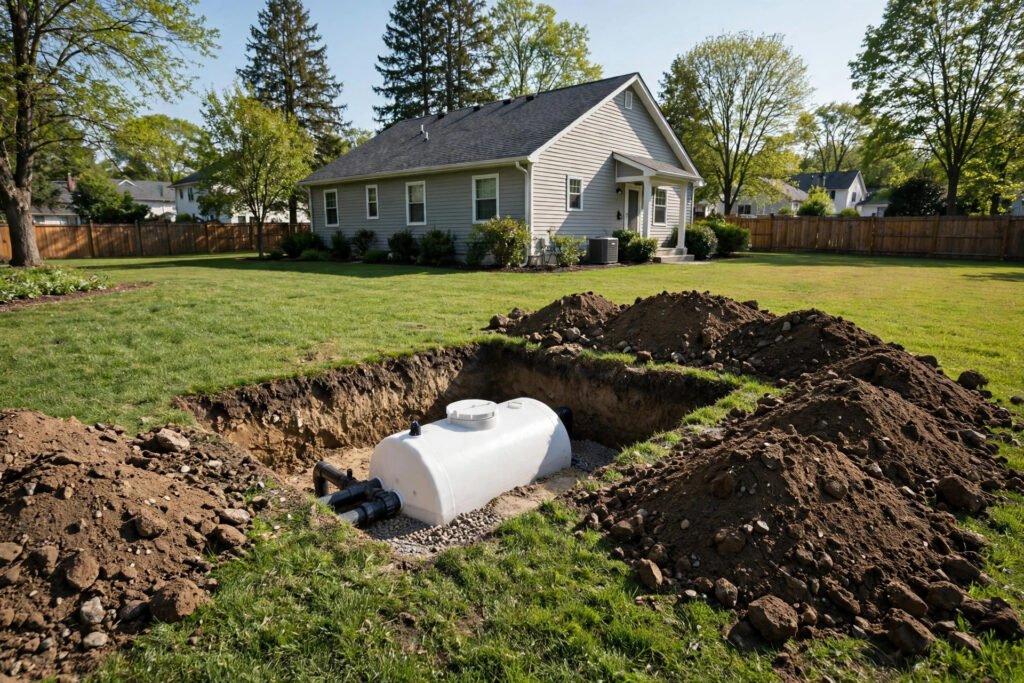
Start with the soil, not the tank. Before anyone can give you an honest number for a septic job, someone has to know how your ground absorbs water, how high the water table sits in spring, and how many bedrooms the system has to serve. Your septic system cost is decided by those three facts more than by the tank itself — the same 1,000-gallon tank can be part of a straightforward $12,000 installation on sandy, level ground or a $35,000 engineered system on tight clay with a high water table. That is why septic bids spread so widely, and why the smartest move a homeowner can make is not collecting more bids, but asking better questions of the bids they already have.
This guide is a hiring checklist, not a price list with a tank photo. It gives you the 11 questions that separate a careful installer from a costly mistake, explains what a good answer sounds like versus a vague one, and then lays out the 2026 planning ranges for pumping, repairs, replacement, and new installation so you can hear each answer in context. Ask the questions in order. The first three happen before any digging is quoted at all.
Before the quote: the ground decides the system
Question 1: Has a soil test / perc test been done on my lot — and can I see the results?
Every legitimate septic design starts with the soil. A perc test (percolation test) and soil evaluation measure how quickly water moves through the ground and identify the seasonal high water table, the depth to bedrock or hardpan, and the soil layers a health department will design around. In many counties the test is performed or witnessed by the local health department or a licensed soil evaluator, and the written result drives the system type and the size of the drain field (also called a leach field).
Good answer: “Yes — here is the evaluation, here is the percolation rate, and here is the system type it allows.” Vague answer: “Your soil looks fine, we do this all the time.” Soil that “looks fine” from a truck window has produced some of the most expensive failures in this trade: a conventional field installed in soil that needed an alternative system, failing within a few years and costing more to replace than the correct system would have cost on day one. If no test exists yet, the honest first quote is for the test itself — commonly a few hundred dollars — not for the system.
Question 2: What system type are you proposing, and why does my site require it?
There is no single “septic system.” The main types a homeowner will hear about are:
- Conventional system — a septic tank plus a gravity drain field of trenches or beds. The least expensive option, and only available where soil, water table, and space all cooperate.
- Chamber system — plastic chambers instead of gravel trenches in the field. Similar cost family to conventional, sometimes easier to install in tight access.
- Mound system — an engineered, raised sand mound used where the water table is high or soil drains too slowly or too quickly. Noticeably more expensive because of the sand, the pump, and the construction.
- Aerobic treatment unit (ATU) — a powered unit that treats wastewater to a higher level before dispersal, sometimes paired with a smaller field or drip dispersal. Higher upfront cost and ongoing maintenance and electricity.
- Sand filter / alternative systems — used in specific soil or setback situations under local rules.
The question is never which system is “best” in general. It is which system your soil report and your county’s rules allow — and a good installer can point at the line in the soil evaluation that decides it. If two bidders propose two different system types for the same lot, that disagreement is the most important thing to resolve before price is discussed at all, and the health department or the soil evaluator is the referee, not the cheaper bidder.
Question 3: Who pulls the permit, and will the installation be inspected?
Septic work is health-code work. Almost everywhere, a new installation or a full replacement requires a permit, a design that matches the soil evaluation, and at least one inspection before the field is covered. Tank-only swaps and major repairs are permitted in many jurisdictions too, while routine pumping usually is not.
Good answer: the installer names the permitting office, includes the permit in the written scope or prices it as a clear line, and schedules the inspection. Red flag: any suggestion to skip the permit to save money or time. An unpermitted system can surface at resale — literally undocumented in county records — and turn into a discount demand or a replacement at the seller’s expense. This is the same permit discipline our fence installation cost and permits guide applies outdoors: the paperwork is part of the project, not an optional extra.
Septic system cost in 2026: the ranges behind the questions
With the ground understood, here are the planning ranges the rest of the questions refer back to. All figures are national planning ranges for 2026; costs vary by region, materials, and scope, and soil, system type, and access move any property within — or beyond — its band. Run your own situation through our free Project Cost Calculator for a first sanity check before you compare bids.
| Job (2026) | What it covers | Typical planning range |
|---|---|---|
| Soil evaluation / perc test | Test pits, percolation testing, written report used for design and permit | $300 – $750 |
| Septic pumping (existing tank) | Pump-out of a standard residential tank, disposal, basic inspection of baffles and levels | $300 – $650 per visit |
| Minor repair (baffle, filter, lid, riser) | Small tank components, often found during pumping | $150 – $900 |
| Pump, alarm, or control replacement | Effluent or dose pump, floats, alarm panel | $600 – $2,000 |
| Drain field repair (partial) | Replacing a failed section or adding a field line where allowed | $2,000 – $7,000 |
| Tank replacement only | New tank set, old tank pumped, decommissioned or removed per local rules | $3,000 – $8,000 |
| Full conventional replacement | Tank + conventional drain field, permitted and inspected | $12,000 – $25,000 |
| Mound or aerobic system replacement / new install | Engineered system where soil or water table requires it | $20,000 – $40,000+ |
| New conventional installation (new construction) | Tank + field on a tested, permitted lot | $10,000 – $22,000 |
Read the table the way an installer does: pumping and small repairs are maintenance-scale money, a tank is a mid-size project, and the drain field is where the real cost lives. A failed field — not a failed tank — is the usual reason a “septic problem” becomes a five-figure project. That distinction drives the next group of questions, because a bidder who quotes a full system when only a component has failed is making the same sorting error as the foundation salesperson in our foundation repair cost decision guide: selling the largest method before naming the actual failure.
Sizing and scope: what exactly is being installed?
Question 4: What tank size and field size are you installing — and what bedroom count is it rated for?
Septic systems are sized primarily by bedrooms, not by the number of people currently living in the house, because bedrooms are what the permit and a future buyer’s lender will count. A common residential pattern is roughly 1,000 gallons for up to three bedrooms and 1,250–1,500 gallons for four to five bedrooms, but local code sets the real numbers, and field size follows the soil’s absorption rate. Ask for both figures in writing, with the rated bedroom count. A system sized for today’s two occupants but permitted for fewer bedrooms than the house has is a quiet resale problem and, in some counties, a code problem.
Question 5: What is included in “restoration” when you leave?
A septic installation is excavation. Lawns are cut open, driveways are sometimes crossed, and landscaping that took years to establish can be in the dig zone. Bids differ enormously on what happens afterward: rough grading only, or grading plus topsoil, seed, and straw? Is a damaged driveway section, walkway, or irrigation line repaired, patched, or explicitly excluded? Are removed trees or shrubs part of the price — and if a tree in the field area has to come out, is that priced using the same size-and-access logic as our tree removal cost guide, or is it a surprise line later? Get restoration in writing. On septic jobs, the cheapest bid is very often just the bid that restores the least.
Question 6: What happens to the old tank and the old field?
Abandonment has rules. An old tank is typically pumped, then crushed and filled in place or removed, under local requirements — not simply disconnected and forgotten, where it can eventually collapse and leave a sinkhole. An old field is usually left undisturbed once disconnected, but the installer should say so plainly and mark the new field’s location on a simple site sketch you keep. Ask for that sketch and the permit paperwork at the end of the job; together they are the record a future buyer, pumper, or repair crew will need. Homeowners who keep that kind of dated paper trail are following the same habit our 12-step contractor hiring checklist recommends for every trade.
Repair or replace: sorting the failure before pricing it
Question 7: What exactly has failed — tank, pump, or field — and what evidence shows it?
Septic symptoms overlap badly. Slow drains, gurgling, wet spots over the field, sewage odor, and backups can each be caused by a full tank overdue for pumping, a crushed or blocked line, a failed pump, a clogged filter, or a genuinely exhausted drain field — in roughly ascending order of price from a few hundred dollars to tens of thousands. A careful diagnosis may include opening the tank, checking sludge and scum levels, inspecting baffles and the effluent filter, and, where the field is in question, test holes or a camera in the lines.
Be cautious with instant verdicts. “Your field has failed, you need a whole new system” delivered within ten minutes, without opening anything, deserves the same skepticism as the red flags catalogued in our guide to contractor scams and red flags. Equally, a pumper who only ever recommends pumping is not diagnosing either. The evidence question — what did you look at, and what did it show? — is the whole game, and it is why routine maintenance help priced like the jobs in our handyman cost per hour guide should never be confused with a licensed septic diagnosis: the small visit is for the small fix, the licensed evaluation is for the system decision.
Question 8: If this is a repair, how long should it reasonably last — and what would make replacement the smarter spend?
Honest repairs come with honest horizons. A new pump on a healthy system can serve for years. A partial field repair on a field that is biologically exhausted may buy one season or five — and a good contractor will say which end of that range your evidence suggests, and why. Ask for the comparison in numbers: repair price and expected life versus replacement price and expected life, side by side. That cost-per-year framing is the same one our water heater replacement cost guide uses for repair-versus-replace decisions inside the house, and it works identically underground. What you are listening for is a contractor willing to price both paths. A company that only quotes replacement has answered a different question than the one you asked.
Question 9: Are there setbacks or site limits that shrink my options?
Septic fields must sit at required distances — setbacks — from wells, property lines, buildings, driveways, waterways, and sometimes pools and gutters discharge points, with the distances set by state and county code. On small or already-developed lots, setbacks are often what force an alternative system or a relocated field, and they can also limit a future addition, deck, or outbuilding. Ask the installer to walk the lot and name the constraints out loud, and ask what reserve area (space kept for a future replacement field, required in many counties) your lot has. Learning your reserve area after building a patio over it is an expensive education.
Living with the system: maintenance and total cost
Question 10: What maintenance does this system need, who does it, and what does it cost per year?
A conventional system mostly asks for pumping every three to five years for a typical household (more often with a garbage disposal, a large household, or a small tank), plus reasonable water habits. An aerobic or other advanced system usually requires a maintenance contract, periodic service visits, and electricity — a real annual cost, commonly a few hundred dollars a year, that belongs in the comparison between system types from the start. Ask whether the installer provides the maintenance plan, what it includes, and whether the county requires proof of it. Then protect the field day to day: no driving or parking over it, no building over it, plant only shallow-rooted grass above it, and keep roof and surface water directed away — a detail that connects this underground system to the above-ground drainage priced in our guides, since water delivered to the wrong place underground and on the surface causes the same kind of damage.
Small recurring care is also where a trusted local helper earns their keep for the visible parts — risers, lids, alarms, and access points kept clear and intact are the kind of small jobs fairly priced in our handyman cost guide — while anything involving opening, pumping, or repairing the system itself belongs to a licensed septic professional.
Question 11: Can I have the full scope in writing, with no decision today?
The final question is the filter for all the others. A complete written septic proposal names: the soil evaluation it is based on, the system type and why, tank and field size with rated bedrooms, the permit and inspection, old-tank handling, excavation protection, restoration, the warranty (and what it excludes — field performance warranties in particular vary widely), the payment schedule, and the maintenance requirement. It also survives being compared against two competing proposals built on the same soil report, checked once more against the Project Cost Calculator for overall range sanity.
Pressure to sign immediately because “the crew has an opening Thursday” is not a scheduling fact, it is a sales technique — and on a permitted, soil-dependent, five-figure underground system that no one can fully see once it is buried, the written record is the only version of the job you will ever be able to verify. Take the paperwork home. The ground is not going anywhere, and neither should your deposit until the eleven answers are on paper.
Frequently asked questions
How much does a septic system cost for a typical house in 2026? For a full replacement, a conventional system commonly lands around $12,000–$25,000 installed and permitted, while mound or aerobic systems required by difficult soil commonly run $20,000–$40,000 or more. Pumping an existing system is $300–$650, and many repairs fall between $150 and $2,000. The soil evaluation, not the house, is what places a given property in its band.
How long does a septic system last? A well-installed conventional drain field commonly serves 20–30 years or more with regular pumping and sensible water use; tanks themselves can last considerably longer, and steel tanks (mostly older) are the shortest-lived exception. Pumps, filters, and aerobic components are shorter-lived parts replaced within the system’s life. Neglect — especially never pumping — is the most common reason fields fail early, because solids carry over and clog the soil interface.
How do I know if my drain field is failing? The classic signs are persistently wet or spongy ground over the field, unusually lush green growth there in dry weather, sewage odor outdoors, slow drains throughout the house, and backups at the lowest fixtures. Any one sign has cheaper possible causes, which is why Question 7 matters: get the tank opened and the components checked before accepting a field-failure verdict.
Can I install or replace a septic system myself? In most jurisdictions, no — design, permitting, and installation are restricted to licensed installers and approved designers, and the work must be inspected. Homeowners can typically handle their own maintenance habits and record-keeping, and in some places their own pumping is not the barrier so much as legal disposal of the waste, which requires licensed hauling. Treat this as a licensed trade throughout.
Does homeowners insurance cover septic replacement? Generally not for age, wear, or gradual field failure — those are maintenance. Sudden, accidental damage (a vehicle crushing a tank, for example) is sometimes covered depending on the policy. Read your own exclusions, and do not let a sales visit interpret your policy for you.
How long does installation or replacement take? The field work for a conventional replacement is often two to four days once permits and inspections are sequenced, weather and soil permitting. The calendar around it — soil evaluation, design, permit review — commonly runs several weeks. Advanced systems and wet-weather delays extend both. Start in a dry season if the current system still functions, rather than in an emergency when it does not.
Prices are national averages for planning purposes; your local quotes will vary by region, materials, and scope. Always get at least three written bids on the same scope before you hire.
About this guide
This guide was researched and written by the Find Contractor editorial team for US homeowners. Cost figures are national planning ranges built by comparing multiple published 2025–2026 cost sources — they are not a quote. See How We Research Costs for our full method, and always get at least three written, itemized bids before you hire.