
Foundation Cracks: Which Ones Need Repair, Which Ones Just Need Watching
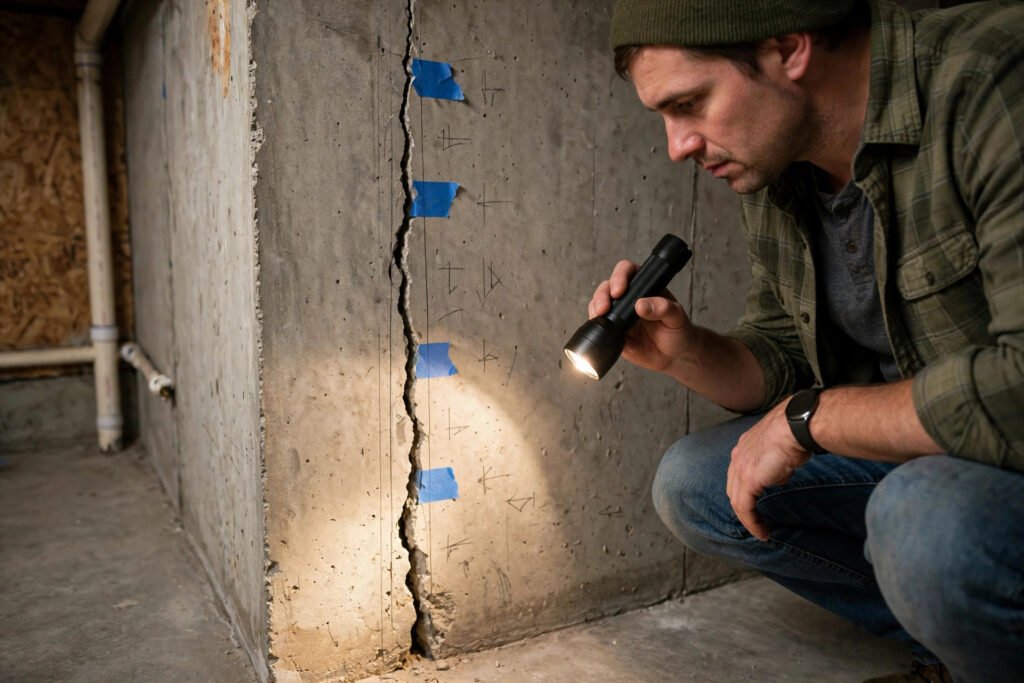
Start in the basement, not on the phone. Take a flashlight, a pencil, and a strip of painter’s tape, and walk the inside walls slowly. Every house with a concrete foundation has a crack somewhere — concrete shrinks as it cures, soil settles, and seasons move things a fraction at a time. Most of those cracks are cosmetic history. A few of them are the house telling you, early and cheaply, that something underneath is still moving. Your foundation repair cost depends almost entirely on telling those two groups apart before you call anyone, because the honest version of this job ranges from a $0 monitoring habit to a five-figure stabilization — and a salesperson who skips the sorting step will happily quote you the second one for a crack in the first group.
This guide is a decision guide, not a scare sheet. It walks the cracks the way an inspector does — direction, width, pattern, and whether they are changing — then prices the real repairs by method, then gives you the questions that separate a foundation company from a foundation sales company. Do the walk first. Make the calls second.
The 20-minute crack walk: what to record before anyone quotes you
You do not need engineering tools. You need consistent observations, dated, so that “is it moving?” becomes a question with an answer instead of an argument.
For each crack you find, record four things:
- Direction — vertical, horizontal, diagonal, or stair-step (following mortar joints in block or brick). Direction is the single most informative fact about a crack; it points at the cause.
- Width, in plain comparisons — hairline (a fingernail will not catch), about a credit-card edge (roughly 1/16 inch), a pencil width (about 1/4 inch), or wider. Professionals measure in fractions; these comparisons get you close enough to sort.
- Through or surface? — does the crack appear on both sides of the wall, or line up with a crack in the floor, a sticking door, or a sloped room above? A crack that shows up in the living space is telling a bigger story than one that lives only on a basement wall.
- Water — any staining, dampness, white mineral crust (efflorescence), or a history of seepage after rain? Water changes both the urgency and the fix.
Then do the one thing almost no homeowner does and every good inspector respects: mark and date it. Draw a short pencil line across the crack at its widest point, write today’s date beside it on painter’s tape, and take a phone photo with a coin in frame for scale. Recheck in 60–90 days, and after any major rain or freeze. A crack that has not changed across a season is evidence. A crack whose pencil line has split is evidence of the opposite kind — and either way, you now own the facts when a bidder walks in. That dated-record habit is the same discipline our 12-step contractor hiring checklist applies to quotes: write it down, date it, compare like with like.
Sorting the cracks: watch, seal, or call
Usually watch: vertical hairlines
Thin vertical cracks — hairline to about 1/16 inch, running roughly straight up and down, often near the middle of a poured wall or below a window corner — are the classic shrinkage and minor settlement cracks of a curing foundation. They commonly appear in the first years of a home’s life and then stop. On their own, with no offset (one side higher or pushed in relative to the other), no water, and no change across your dated checks, they belong in the watch group: photograph, mark, move on. If one seeps during heavy rain, it graduates to the seal group below — a waterproofing fix, not a structural one.
Usually seal: non-structural cracks that leak
A stable crack that lets water in is a nuisance with a known, modest price. The standard fixes are low-pressure epoxy or polyurethane injection from inside (polyurethane is the usual choice for actively leaking cracks because it flexes and expands; epoxy is stronger and used where some structural bonding is wanted on a crack already judged non-structural), or exterior excavation and membrane work when interior injection has failed or the crack is part of a wider waterproofing problem. Budget bands for these are in the cost table below — note how far they sit from stabilization prices. If a quote for a leaking hairline arrives wearing piers, something has gone wrong in the sorting.
Call promptly: the patterns that mean movement
Get a professional assessment — promptly, not panicked — when you see any of these:
- Horizontal cracks across a basement wall, especially with any inward bowing of the wall. Horizontal means pressure from outside soil pushing in, a different and more serious mechanism than shrinkage.
- Stair-step cracks climbing through block or brick mortar joints, particularly wider at the top, or paired with cracks in the interior walls above.
- Diagonal cracks that are wider at one end than the other, or that reappear through a previous repair.
- Offset or displacement — one side of the crack pushed in, out, or down relative to the other. Offset means the two sides are no longer moving together.
- Company it keeps — doors and windows that newly stick or will not latch, gaps opening at ceilings or baseboards, floors that feel newly sloped, a chimney pulling away from the house, or exterior brick cracks that mirror interior ones. A crack plus symptoms is a system signal, not a cosmetic flaw.
- Rapid change — your dated pencil line split within weeks, or a crack you can fit a pencil into that was a hairline last season.
None of these automatically means the most expensive repair. They mean the cause needs naming by someone qualified before any method is sold. Bowing walls, for example, are often addressed with wall anchors or carbon-fiber straps at a fraction of piering cost — but only a real diagnosis distinguishes that case from genuine settlement.
Foundation repair cost in 2026: prices by method, not by fear
Here are the planning ranges once a crack or symptom has been sorted into the “actually repair it” group. All figures are national planning ranges for 2026; costs vary by region, materials, and scope, and soil, access, and how much of the perimeter is involved move any house within — or beyond — its band. Run your own situation through our free Project Cost Calculator for a first sanity check before quotes arrive.
| Repair (2026) | What it actually does | Typical planning range |
|---|---|---|
| Crack injection (epoxy or polyurethane), per crack | Seals a stable, non-structural leaking crack from inside | $300 – $800 per crack |
| Exterior crack excavation + membrane | Waterproofs a problem crack from outside where injection is not enough | $1,000 – $3,000 per location |
| Carbon-fiber straps, per strap | Arrests inward bowing of a block wall (installed, spaced per engineer/company spec) | $350 – $700 per strap |
| Wall anchors, per anchor | Ties a bowing wall back to stable soil beyond the foundation | $800 – $1,500 per anchor |
| Interior drain + sump system | Manages water under/around the floor rather than structural repair | $2,500 – $6,500 typical install |
| Steel push piers or helical piers, per pier | Transfers foundation load to deeper stable soil — the core stabilization method | $1,200 – $2,500 per pier |
| Typical piering job (often 6–12 piers on the affected side) | Stabilizes the settling portion of a house | $8,000 – $20,000+ |
| Slab / mud jacking or foam lifting, per project | Raises settled flatwork or slab sections | $800 – $3,500 typical project |
| Full perimeter stabilization (severe, multi-side settlement) | Piers around most or all of the house | $20,000 – $40,000+ |
Read the table from the top down, because that is how an honest diagnosis reads it too. The gap between a $500 injection and a $15,000 piering job is not a pricing disagreement — it is a disagreement about what is wrong. That is why the sorting sections above matter more than the numbers: get the diagnosis right and the price mostly takes care of itself. It is also why bids for foundation work spread wider than bids in almost any other trade. The same spread discipline helps elsewhere in the house: our concrete driveway cost guide shows how per-square-foot pricing exposes a padded flatwork bid, and this table does the same job per method here.
Three cost factors explain most of the spread inside each band. Access — piers and exterior work need digging room; finished landscaping, decks, and tight side yards add labor, much as access drives the numbers in our gutter installation cost and exterior guides. Soil and depth — piers are priced to reach stable soil, and nobody knows that depth exactly until digging starts, which is why reputable contracts state a per-pier price with a depth term rather than pretending certainty. How much is moving — one corner settling is a different job from two full walls, and a quote should name the affected sides on a simple house diagram. If it does not, ask for one.
Who should diagnose it: contractor, or engineer?
This is the highest-value decision in the whole process, and it costs a few hundred dollars to get right.
A foundation repair company will usually inspect for free — and then sell the repair it installs. Many are honest and excellent. But the incentive structure is obvious, and on a five-figure decision it deserves a counterweight. A licensed structural engineer, hired by you and selling nothing else, will typically assess a house for roughly $300–$800 depending on region and report depth, and will give you a written finding: what is moving, why, what (if anything) needs doing, and sometimes the method and spacing if piers or anchors are warranted. If the finding is “monitor it,” you have bought certainty for the price of a minor repair. If the finding is “stabilize the east wall,” you now own a specification you can hand to three companies to bid on the same work — the single strongest negotiating position a homeowner can hold in this trade.
Consider the engineer route mandatory when: more than one pattern from the “call promptly” list is present, a company has quoted five figures, you are buying or selling the house, or two companies have already given you two different diagnoses. The monitoring habit helps the engineer too — bring your dated photos. Small interior symptoms are worth sorting at the same visit: the hairline drywall cracks above doors that often accompany settlement are cosmetic cousins of this topic, and our drywall cost guide prices those patches honestly so they do not get folded into a structural quote at structural prices.
The 10 questions to ask any foundation company
Bring these to every bid visit, and write the answers down. Good companies answer them plainly; the answers themselves are the comparison.
- What is causing this — settlement, soil pressure, water, or shrinkage — and what evidence points there? A diagnosis names a mechanism, not just a product.
- Is it still moving? How do you know? If the honest answer is “we cannot tell yet,” monitoring or an engineer comes before piers.
- What happens if I do nothing for a year? A trustworthy company can describe the do-nothing path without theatrics.
- What is the least invasive method that addresses the cause — and why is it (or isn’t it) enough here?
- Exactly where, on a diagram of my house, does work happen — how many piers/anchors/straps, at what spacing?
- Is the pier price fixed, or per foot of depth? What is the depth term in writing?
- What does the warranty actually cover — the pier, the lift, future movement of that wall — and is it transferable when I sell? For how long, honored by whom? Foundation warranties are marketing-heavy; read the exclusions.
- Will you pull permits where required, and will the work be inspected?
- What is restored when you leave — excavated soil, landscaping, interior finishes, the slab you cut? Restoration is where low bids quietly end.
- Can I have this in writing to compare, with no decision today? Pressure to sign on the spot for a structural repair is itself a finding — the same one catalogued in our guide to contractor scams and red flags.
While the company is on site, keep the scopes separate. A foundation visit is not the moment to bundle in unrelated work at bundle prices invented in your basement; if genuine follow-on items surface — grading, drainage, exterior repairs — price them separately later, using the same per-project logic as our landscaping cost guide for the yard restoration that excavation leaves behind.
Water: the cause hiding behind half of these cracks
Before any structural method is approved, walk the outside of the house in the rain — or reconstruct the last storm honestly. Soil pressure and settlement both get dramatically worse when water is being delivered to the foundation by the house itself. Check these first, because they are cheap relative to everything in the table above:
- Gutters and downspouts — overflowing gutters dump roof water at the wall; downspouts should discharge several feet away from the foundation, not at its base. A failed gutter run is a few hundred dollars of cause behind a five-figure symptom.
- Grading — soil should slope away from the house on all sides. Settled backfill against the wall (very common in the first decade) quietly reverses that slope.
- Window wells and stairwells — drains clogged or covers missing turn these into funnels.
- Plumbing leaks — a slow supply or drain leak under a slab or near a wall can soften soil for years before it shows inside. Unexplained water with no rain pattern belongs on the diagnostic list; our water heater replacement cost guide covers one common hidden source, and a plumber’s leak check is cheap compared to piers.
Fixing water does not un-settle a settled corner. But stabilizing a foundation while the downspout still pours against it is paying full price to fight a cause you left running. Sequence matters: water first, monitoring second, structure third — unless the structure is actively failing, in which case your engineer sets the order.
What you can safely do yourself
Monitoring — the dated pencil lines, photos, and a simple crack gauge (inexpensive plastic tell-tales that straddle a crack and show movement) are genuinely useful DIY, and inspectors respect the records. Cosmetic patching of a crack already sorted as stable and non-structural — after a season of no change — is ordinary homeowner territory, on the same scale as the small jobs priced in our handyman cost guide and the hourly breakdown in handyman cost per hour if you would rather hand it off. Exterior water fixes — extending downspouts, regrading a settled bed, clearing a window-well drain — are weekend-scale work with outsized effect.
Stop at the structural line. Do not inject a crack that has not been sorted (sealing a moving crack just hides the evidence), do not attempt any lifting, shimming, or jacking of a foundation, and do not patch over a “call promptly” pattern to make it presentable for a sale without disclosure — that converts a repair problem into a legal one. And if a crack is paired with a sagging floor, interior support work belongs to a pro assessment too; knowing the price of adjacent repairs from our window replacement cost guide is useful context for a renovation budget, but it is not a substitute for a structural finding.
Frequently asked questions
How much does foundation repair cost for a typical house in 2026? It depends entirely on the sort. A stable leaking crack is commonly $300–$800 to inject. A bowing wall addressed with straps or anchors commonly lands in the low thousands. True settlement stabilized with piers is the expensive tier — often $8,000–$20,000+ for the affected side of a house, at roughly $1,200–$2,500 per pier. Anyone quoting a “typical” figure before diagnosing the cause is guessing with your money. Get a second pass from the Project Cost Calculator once you know which method, if any, you are actually pricing.
Are foundation cracks normal in a new house? Hairline vertical shrinkage cracks in the first few years are very common and usually stabilize. What is not “just settling” at any age: horizontal cracks, offset, stair-step cracks that keep growing, or cracks accompanied by sticking doors and sloping floors. Newer homes may also carry builder warranty coverage for structural defects — check your warranty documents before paying anyone, and document cracks with dated photos either way.
Does homeowners insurance cover foundation repair? Generally, no for settlement, shrinkage, and soil movement — those are treated as maintenance and earth-movement exclusions in most policies. Sudden, accidental events (a burst pipe that undermines a slab, for example) sometimes trigger coverage for the resulting damage. Read your own policy’s exclusions, and do not let a sales visit tell you what your insurer will pay.
Should I repair a foundation before selling? Get the diagnosis first — ideally an engineer’s written report. Some findings are monitor-and-disclose items that barely affect a sale; others are cheaper to repair with a transferable warranty than to discount for, because an undiagnosed crack scares buyers into assuming the worst tier. Either way, an honest paper trail (dated photos, report, any invoices) sells better than a fresh cosmetic patch over an unexplained crack.
How long does foundation repair take? Injection is a few hours. Straps or anchors are commonly one to two days. A typical piering job on one side of a house runs about two to five days including excavation and cleanup, weather and soil permitting. The calendar around the work — engineer’s visit, permits where required, scheduling — usually adds more time than the work itself, so start the diagnosis well before a listing date or a renovation that depends on the foundation being settled.
Prices are national averages for planning purposes; your local quotes will vary by region, materials, and scope. Always get at least three written bids on the same scope before you hire.
About this guide
This guide was researched and written by the Find Contractor editorial team for US homeowners. Cost figures are national planning ranges built by comparing multiple published 2025–2026 cost sources — they are not a quote. See How We Research Costs for our full method, and always get at least three written, itemized bids before you hire.