
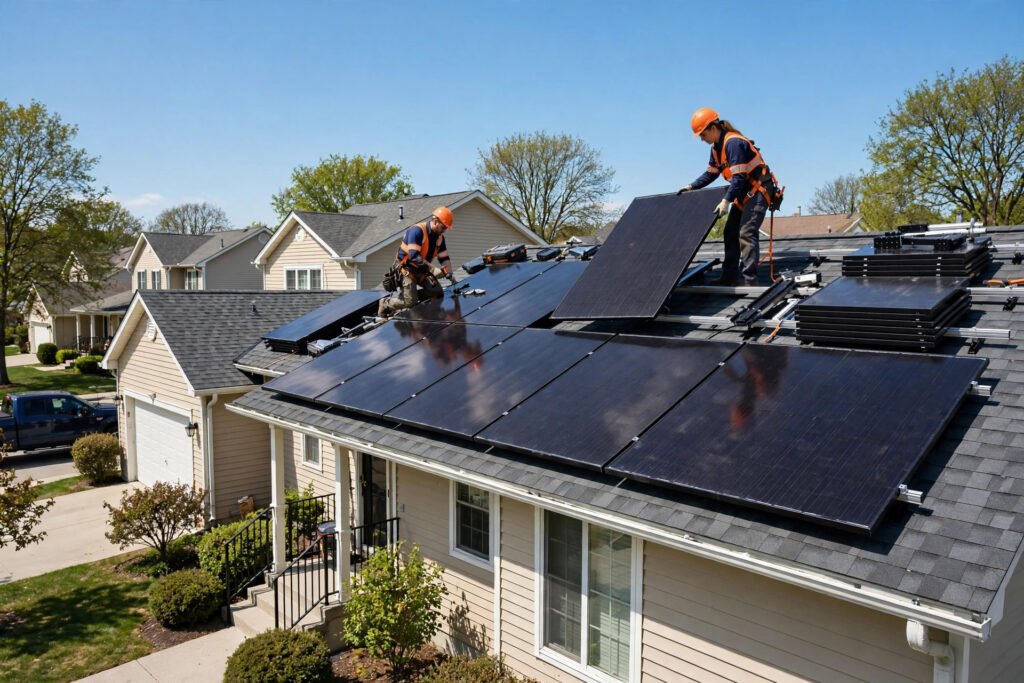
Solar Panel Cost in 2026: System Prices Before and After the Federal Credit
Start with your electric bill, not with a panel count. Pull the last twelve months of bills, add up the kilowatt-hours, and look at the roof you actually have — its age, its direction, and how much of it sits in shade at 2 p.m. Your solar panel cost is decided by those two sheets of paper more than by any panel brand: the same 8-kilowatt system can be a straightforward $24,000 rooftop install on a new, south-facing roof or a $34,000 project once a re-roof, a main-panel upgrade, and tree work are honestly added. That is why solar quotes spread so widely, and why the first job is not collecting more quotes — it is sizing the system to your real usage before anyone prices it.
This guide works in a different order than most cost pages. It starts with the bill-and-roof check that determines system size, then prices systems by size — gross price first, then the net figure after the federal credit, stated separately so you can see both numbers — then separates the add-ons that quietly inflate a headline quote, and only then talks about payback. No savings are promised here. Production, rates, and rules vary too much by roof and by state for an honest national page to promise them.
Start with the bill and the roof: the two checks that size the system
Check 1: How much electricity do you actually use?
Solar is sized in kilowatts (kW) of capacity, but it is bought to cover kilowatt-hours (kWh) of use. A household using about 10,000–11,000 kWh a year — close to a common US planning figure — often looks at roughly a 7–9 kW system in a sunny region and a larger one where winters are cloudy, because the same panel produces fewer kWh per year there. A household using 6,000 kWh should be suspicious of a 12 kW proposal, and a household using 18,000 kWh (pool pump, EV, electric heat) should be suspicious of a 6 kW one priced to look cheap.
Bring the twelve-month total to every bid visit, not the best month and not the worst. Any installer who quotes before asking for it is sizing to a sales target, not to your meter. If your usage is about to change — an EV arriving, a heat pump replacing a furnace, a teenager leaving for college — say so out loud, because sizing follows the next five years of use, not last year’s alone.
Check 2: Will this roof hold panels for 25 years?
Panels are a 25-year commitment screwed to a roof with a finite life. Three roof facts move the price before a single panel is ordered:
- Age and condition. If the roof has less than about 10 years of life left, most honest installers will recommend re-roofing the panel area first — removing and reinstalling panels later to fix a leaking roof underneath them is a four-figure avoidable cost. Price that work with the same discipline as our average cost to replace a roof guide, as a separate line, not folded invisibly into the solar total.
- Direction and shade. South-facing is the textbook ideal in the northern hemisphere; east and west roofs still produce usefully, usually somewhat less per panel, which can mean a few more panels for the same kWh. Shade is the harder limit: a chimney shadow is manageable with modern panel-level electronics, a mature oak canopy is a different project — and if branches have to come down, that work is priced by the size-and-access logic in our tree removal cost guide, not as a free extra.
- Structure and surface. Tile, slate, and very steep roofs cost more to work on than standard asphalt shingle; older framing sometimes needs a structural check. None of this is a reason to abandon solar — it is a reason the site visit must happen before the final price, not after the contract.
Do the cheap efficiency work first, too. A house that wastes less electricity needs a smaller system. The attic and air-sealing priorities in our insulation cost seasonal guide commonly cost a fraction of one kilowatt of panels and pay back on heating and cooling whether or not solar ever happens.
Solar panel cost in 2026: prices by system size
With usage and roof understood, here are the planning ranges. All figures are national planning ranges for 2026 for a standard rooftop, grid-tied system without a battery, installed and permitted; costs vary by region, materials, and scope, and roof type, electrical work, and local labor move any home within — or beyond — its band. The federal credit column shows the arithmetic of the 30% Residential Clean Energy Credit as it is commonly described for eligible owner-owned systems — it is not a guarantee of your personal tax outcome (see the credit section below), and you should confirm current rules with a tax professional before relying on it. Run your own total through our free Project Cost Calculator as a first sanity check before you compare bids.
| System size | Typical annual production context | Gross installed range (2026) | 30% credit arithmetic | Net after credit (illustrative) |
|---|---|---|---|---|
| 4 kW (small / low use) | Covers a smaller or very efficient home, or part of a larger home’s use | $11,000 – $15,000 | −$3,300 – $4,500 | $7,700 – $10,500 |
| 6 kW | Common starting size for moderate use | $16,000 – $21,000 | −$4,800 – $6,300 | $11,200 – $14,700 |
| 8 kW | Common for a household near 10,000–11,000 kWh/year in a sunny area | $21,000 – $27,000 | −$6,300 – $8,100 | $14,700 – $18,900 |
| 10 kW | Larger use: EV, pool, or electric heat in the mix | $26,000 – $33,000 | −$7,800 – $9,900 | $18,200 – $23,100 |
| 12 kW (large) | High use or lower-production climate | $31,000 – $39,000 | −$9,300 – $11,700 | $21,700 – $27,300 |
Read the table in gross dollars first. The gross price is what you sign for, what you finance if you finance, and what determines whether the installer’s per-watt math is honest. A useful cross-check is price per watt: divide the gross total by the system watts (8 kW = 8,000 watts). Standard rooftop systems in these bands commonly land around $2.60–$3.30 per watt before any credit. A quote far below that band usually excludes something the others include; a quote far above it needs an itemized reason — premium equipment, difficult roof, battery, or ground mount — named in writing.
Notice what the table does not do: it does not subtract state incentives, because those range from meaningful programs in some states to nothing in others, and it does not promise a payback date. Both are handled in their own sections below, in that order, because a payback claim built on an incentive you do not qualify for is worth nothing.
What the per-watt price should include — and what it often doesn’t
A complete rooftop quote normally includes the panels, the inverter (string inverter or microinverters), racking and flashing, the wiring to your main panel, monitoring hardware, the permit, the utility interconnection application, and the installer’s workmanship warranty. When two quotes differ by thousands, the difference is usually hiding in this second list — the add-ons:
| Add-on (2026) | When it is genuinely needed | Typical planning range |
|---|---|---|
| Battery storage (about 10–13.5 kWh) | Backup during outages, or storing daytime power for evening use where export rates are low | $8,000 – $14,000 installed, before any credit treatment |
| Main panel upgrade (100A → 200A is common) | Panel is full, undersized, or a brand the utility/insurer flags | $1,500 – $3,500 |
| Re-roof of the panel area | Roof has under ~10 years of life left | Priced as roofing — see roof guide; commonly several thousand and up by area |
| Ground-mounted system instead of rooftop | Roof unsuitable; yard space available | Commonly 10–20% above the same-size rooftop system (racking, trenching) |
| Trenching / long electrical run | Detached array, distant panel, or difficult route | $500 – $3,000+ by distance and surface |
| Tree trimming or removal for shade | Documented shade on the array area | By tree — see tree removal guide |
| Critter guard / premium monitoring / extended warranties | Optional protections and service plans | $300 – $2,500 depending on scope |
Two of these deserve a direct warning. First, the main panel upgrade is real electrical work with a real price — the hourly logic in our electrician cost per hour guide is the right lens — but it is also the easiest line to pad, so ask what specifically fails about your current panel (capacity, space, condition) and get that answer in writing. Second, a battery should be bought for a stated job: keeping a fridge, medical device, or well pump running in an outage, or shifting power into expensive evening hours. Bought as a vague “everyone adds one,” it is the single largest way a solar quote grows without the homeowner noticing why. Small electrical and mounting odd jobs around a project — a moved outlet, a patched soffit — are the kind of work fairly priced in our handyman cost guide, and in the hourly breakdown in handyman cost per hour; licensed solar and panel work is not handyman work, and the distinction matters for permits and insurance.
The federal credit and state incentives: read them like a contract
The headline incentive for owner-owned residential solar is the federal Residential Clean Energy Credit, commonly described as 30% of eligible system cost for systems placed in service in this period, claimed on your taxes, with rules about eligibility, carryforward of unused credit, and which costs qualify. Three honest cautions belong in every planning conversation:
- It is a tax credit, not a rebate and not a check at signing. If your tax liability in the year is smaller than the credit, the unused portion’s treatment follows current IRS rules — confirm them for your situation rather than taking a salesperson’s summary.
- Rules change. Credit percentages and eligibility have changed by legislation before and can again. The figure in any quote should be labelled with the rule it assumes and the placed-in-service date it depends on; if a deadline is used to pressure you, verify the deadline on an official source before it moves your decision.
- Leased systems and PPAs are different. With a lease or power-purchase agreement, the system owner is the company, not you — so the credit generally belongs to the owner, and any benefit to you is whatever the contract passes through. That is not automatically a bad deal, but it must be compared as a contract, not as a purchase price.
State, utility, and local incentives sit on top of this and vary from substantial to zero, sometimes with waitlists or step-downs as a program fills. Ask each bidder to list every incentive they have assumed as a separate line with its source, so a bid built on a full state rebate can be compared fairly against one that assumed none. Then check the total once more against the Project Cost Calculator in gross dollars — incentives change what you net, not what the work costs.
Payback, without the brochure math
Payback is simply net cost divided by annual bill savings — and every term in that sentence can be honestly moved. A careful estimate states all of its assumptions where you can see them:
- Production: the system’s estimated kWh in year one for your roof, ideally from the installer’s production model with shade accounted for — not a statewide average panel.
- What a saved kWh is worth: power you use yourself avoids buying it at your retail rate; power you export is compensated under your utility’s net-metering or export rule, which in many places now pays noticeably less than the retail rate. A quote that values every produced kWh at the full retail rate is assuming you use or are credited for all of it at that rate — ask whether that matches your utility’s current rule.
- Rate path: savings grow if retail rates rise and shrink if they don’t. Any 25-year savings total is a stack of assumptions about rates, production decline, and your staying in the house; treat it as a scenario, not a forecast.
- Ownership costs: inverter replacement is a common mid-life cost (string inverters often need one replacement within a 25-year panel life; microinverters are typically warranted longer), plus any monitoring or service fees in the contract.
With those stated, many owner-owned systems in sunny, higher-rate areas pencil to a simple payback somewhere in a broad 7–12 year planning band, and systems in low-rate or low-sun areas can run considerably longer — which is sometimes still a fine decision (backup, predictability, resale) as long as it is made with the real number in view. If a proposal shows a four-year payback, the fastest check is the export-rate and rate-increase assumptions; that is where optimistic math usually lives. The sorting habit is the same one our guide to contractor scams and red flags teaches for every trade: the red flag is rarely the product — it is the pressure and the missing paperwork around it.
Permits, interconnection, and the real timeline
The panels go up in one to three days. The project takes considerably longer, and knowing the calendar in advance prevents the most common solar complaint — a finished roof array sitting idle while paperwork clears.
| Stage | What happens | Typical calendar range |
|---|---|---|
| Site assessment + design | Usage review, roof/shade measurement, system design, contract | 1–2 weeks |
| Permitting | Building/electrical permit with your city or county; HOA approval where it applies | 2–6 weeks, varies widely by jurisdiction |
| Installation | Racking, panels, inverter, wiring | 1–3 days of actual work |
| Inspection | Local electrical/building inspection of the finished system | A few days to 2 weeks after install, by inspector availability |
| Utility interconnection / PTO | Utility reviews, may swap or program the meter, then grants Permission to Operate | 1–4 weeks after inspection in many areas |
Do not let anyone switch the system on for regular use before Permission to Operate unless your utility explicitly allows it — and get the PTO letter for your records, with the permit and the final design, in the same folder our 12-step contractor hiring checklist tells you to keep for every major job. That folder is also what a future buyer will ask for: owned systems with paperwork transfer cleanly; systems with a lease or PPA transfer only as well as the contract allows, which is a resale question to ask before signing, not after listing.
Roof penetrations deserve one line of their own in the contract: who warrants the roof against leaks at the mounts, for how long, and does that warranty survive alongside the roof manufacturer’s warranty? A small leak at a mount can become the kind of water problem priced in our gutter installation cost and drainage guides — cheap to prevent with flashing done right, expensive to chase once ceilings stain.
Buy, lease, or PPA: the ownership question in one pass
Buy (cash or loan). You own the system, claim any credit you qualify for, and keep all production value. A loan adds interest to the true cost — compare the loan’s total of payments, not just the monthly figure, and watch for dealer fees built into solar loan pricing that raise the system price itself.
Lease. You pay a fixed (often escalating) monthly amount to host a system the company owns and maintains. Simpler, no credit for you, and the escalator clause — commonly a yearly percentage increase — is the line to read twice.
PPA (power-purchase agreement). You buy the system’s power per kWh from its owner, typically at a rate pitched below today’s retail rate, again often with an escalator. The comparison that matters is the PPA rate path against a realistic retail-rate path over the same years, plus the transfer terms at sale.
None of the three is automatically the right answer. What is never right is signing any of them without the production estimate, the escalator (if any), the transfer terms, and the roof warranty in the same written document.
What you can do yourself — and where the licensed line is
Homeowners can genuinely do the highest-value early work: the twelve-month usage audit, the roof-age check, gathering three itemized bids on the same system size, and verifying every incentive a bid assumes. Monitoring after install — reading the app, noticing a production drop, keeping panels’ shade from creeping back — is also yours, along with the small surrounding jobs priced in our handyman cost guide.
The installation itself is licensed electrical and roofing work throughout: panels, racking, inverters, panel connections, and anything that ties into the grid belongs to the licensed installer under permit and inspection, in every jurisdiction we are aware of. DIY solar kits exist for off-grid sheds and cabins; a grid-tied rooftop system is not a weekend project, and an unpermitted tie-in can void insurance and block a home sale.
Frequently asked questions
How much does a solar panel system cost for a typical house in 2026? For a common 6–8 kW rooftop system, plan on roughly $16,000–$27,000 gross installed before any credit, with the illustrative net after a 30% federal credit around $11,200–$18,900 for eligible owner-owned systems. Batteries, panel upgrades, and re-roofing are separate lines that can add thousands. Your usage total and your roof — not the panel brand — place you in the band.
How many panels is that? Modern residential panels are commonly around 400 watts each, so a 6 kW system is roughly 15 panels, 8 kW about 20, and 10 kW about 25. Panel count matters less than total kW and the production estimate for your roof.
Does solar still make sense if my electric rate is low? It makes the payback longer, which is a fact to plan around rather than a verdict. In low-rate areas the honest case usually rests on a long time in the home, a sunny unshaded roof, available incentives, or valuing predictability and backup — not on a short payback that the arithmetic does not support.
Will solar increase my home’s value? Owned systems with paperwork are generally viewed more favourably by buyers than leased systems that must be transferred and qualified for. How much value, if any, depends on your market, the system’s age, and remaining warranty — do not let a bid assign you a specific dollar increase as if it were appraised fact.
What maintenance does a rooftop system need? Very little routine work in most climates: rain handles much of the soiling, monitoring flags problems, and an occasional inspection of mounts and wiring is prudent, especially after major storms. Budget honestly for a possible inverter replacement over the system’s life unless your equipment warranty covers the full period.
How long do panels last? Panels commonly carry 25-year production warranties with gradual output decline built into the warranty terms, and many keep producing beyond that at reduced output. Inverters and batteries are the shorter-lived components — roughly a 10–15 year planning horizon is common for a string inverter and for a battery’s warranted life.
Prices are national averages for planning purposes; your local quotes will vary by region, materials, and scope. Always get at least three written bids on the same scope before you hire.
About this guide
This guide was researched and written by the Find Contractor editorial team for US homeowners. Cost figures are national planning ranges built by comparing multiple published 2025–2026 cost sources — they are not a quote. See How We Research Costs for our full method, and always get at least three written, itemized bids before you hire.